From Local Projects to Portfolio Strength: Investing in Resilience for Long-Term Returns

Climate resilience can’t wait. It’s a smart, essential investment.

Climate risk is no longer a distant threat; it’s a present reality with tangible financial, social and environmental consequences. It cannot simply be “insured away,” as insurers are repricing coverage or withdrawing due to escalating costs, unreliability of traditional risk models and increased financial instability. That’s leaving asset owners – from homeowners to municipalities to pension funds – to bear the full weight of climate volatility. The undeniable message is this:

Climate resilience is not an option. It’s imperative to preserving an investment’s long-term value.

When insurance providers price out climate-related risk, asset holders must move a layer deeper. We must actively protect assets from climate change impacts rather than relying solely on insurance payouts. This means building resilience into portfolios and projects by designing and upgrading physical assets to withstand our changing environmental realities. The evidence for this approach is compelling.

Consider the billions in losses from recent Canadian disasters. The 2021 floods in British Columbia washed out highways and rail lines, the 2023 Nova Scotia floods damaged critical infrastructure and record-setting wildfires in Alberta and Quebec destroyed communities and disrupted supply chains. In 2024 alone, the Insurance Bureau of Canada found there to be $8.5 billion in insured losses due to extreme weather events. Those losses represent destroyed homes, disrupted businesses, damaged infrastructure, and communities struggling to recover. The economic and social costs of inaction are simply too high.

These are not isolated events, but rather, frequent and recurrent ones that will not abate in the future. Their recurrence signals the urgent need for a market shift that prioritizes investment capital for resilience-focused projects. For institutional investors, this presents a significant new opportunity: the resilience market.

The rise of the resilience market.

Investing in climate adaptation – from resilient infrastructure to nature-based solutions – can deliver long-term stability and value to communities, local and national economies, as well as investors. The resilience market focuses on projects that reduce emissions and actively strengthen communities against the impacts of climate change.

Much of this work begins at the local-level, where a robust resilience investment strategy includes investments in energy systems, transportation networks, community facilities and other local infrastructure. Strengthening the resilience of these critical assets plays a central role in protecting residents, sustaining local economies and ensuring long-term stability.

The challenge of this approach often lies in aggregating, standardizing and de-risking projects, as individual municipal projects are frequently too small or complex for traditional institutional investment. This is where blended finance provides an essential bridge.

The power of blended finance.

Combining public and private capital can be a highly effective approach in activating long-term solutions. Blended finance structures can be underpinned by decades of public-sector expertise in municipal finance, using catalytic public funds to perform three essential functions:

  • Developing an attractive risk-return profile for private partners
  • Standardizing investment structures and creating scale
  • De-risking early-stage projects, especially in new fields such as resilience

By strategically combining public and private capital, blended finance structures can address all three challenges to unlock projects that might otherwise not attract institutional capital. Public funds can be used to absorb the initial risk, making projects more attractive to private investors, while private capital can then be deployed at a scale that public funds alone cannot match.

New models for investing in resilience.

In practice, this means engaging in public-private co-investment and adaptation strategies that make assets stronger. A world of opportunity opens when you co-invest alongside Canadian municipalities and structure funds that unlock risk-adjusted investment opportunities. By structuring funds to reduce downside risk, private capital can be brought in to scale up and accelerate projects that traditionally face a high hurdle rate.

When municipalities seek to upgrade critical infrastructure to enhance and sustain community resilience, a blended finance model could see the municipality provide a portion of the funding, with a private institutional investor providing the rest. The public funding could be structured to guarantee a minimum return or cover a certain percentage of losses, thereby making the project much more appealing to a private investor.

Another model involves a fund that invests specifically in community resilience projects across the country leveraging a combination of public and private capital, with the public contribution focused on addressing the unique risks of these projects. This would enable investment in a portfolio of projects – from seawalls in coastal communities to urban greening projects in cities – reducing the risk for private finance partners while achieving a durable, positive impact.

Case Study: The Better Homes Ottawa Loan Program, which offers financing for home energy retrofits that are repaid over time through property tax bills (a model known as Property Assessed Clean Energy, or PACE), was successfully scaled through a blended finance partnership. After its launch in 2021, the City of Ottawa partnered with Vancity Community Investment Bank (VCIB) in an innovative private-sector funding model that allowed the City of Ottawa to expand the program. The partnership with VCIB included an initial $3.9M credit facility that helped launch the first phase of the program and a second tranche of $30M to expand the program to more residents. The private capital injection allowed the popular program to continue expanding, thereby leveraging private-sector interest to fund essential, local climate action.

For investors, these new financial models offer a credible pathway into a market with demonstrated demand and lasting impact; one with real financial returns. By helping communities adapt, investors not only protect their own investments, but also create new, stable revenue streams.

For communities, it delivers the critical capital required to strengthen infrastructure against floods, fires and extreme heat, protecting citizens and local economies. For Canada as a whole, this approach aligns climate adaptation with financial and economic sustainability, ensuring that resilience is built into both our communities and our portfolios.

A call to unlock resilient investing.

Canada’s responsible investment community is at a pivotal moment. Embracing blended finance and fostering new partnerships between public and private sectors is a real possibility. It’s one that would unlock the capital needed to build a more resilient country. This approach would move us beyond risk management to active value creation, building climate resilience into the very foundation of our portfolios, our communities and Canada’s economic future.

As one of Canada’s leading funders and investors in municipal sustainability projects, the Federation of Canadian Municipalities’ Green Municipal Fund (FCM’s GMF) is uniquely positioned to drive this approach. Leveraging its stable endowment and with decades of success in mobilizing capital for local climate action, a strong network of more than 2,100 member municipalities and a track record of over $1.6 billion invested in more than 2,700 sustainability projects since 2000, GMF serves as a trusted bridge between public and private capital.

Creating bankable, impact-driven opportunities, GMF offers investors a credible pathway to scalable, low-risk municipal projects that meet their expectations for stable, long-term returns. Investors can strengthen their portfolios through smart, essential investments in resilience that create enduring value for both investors and communities.

Now is the time to invest in resilience to turn local projects into long term portfolio strength, unlock stable return, and be a partner in shaping a more sustainable prosperous future for everyone.


RIA Disclaimer

The views and opinions expressed in this article are solely those of the authors and do not necessarily reflect the view or position of the Responsible Investment Association (RIA). The RIA does not endorse, recommend, or guarantee any of the claims made by the authors. This article is intended as general information and not investment advice. We recommend consulting with a qualified advisor or investment professional prior to making any investment or investment-related decision.
Governance of AI: A Stewardship Framework

Artificial Intelligence (AI) is rapidly reshaping economies and societies alike, presenting both significant opportunities and efficiencies, as well as profound governance challenges. The onus falls on institutional investors not only to understand these changes, but to craft stewardship frameworks that ensure responsible, sustainable value creation through AI. TD Asset Management Inc. (TDAM) has undertaken a comprehensive analysis of the available literature on AI governance from a stewardship standpoint. Our goal is to distill actionable insights and build a robust framework tailored to our stewardship program, providing clarity for both internal alignment and external engagement.

Governance of AI and Financial Performance

Early and proactive governance at the board level has emerged as a key differentiator for companies integrating AI. Some research reveals that organizations which began addressing AI governance early – especially at the highest levels – demonstrate outperformance against major benchmarks. The drivers of this success are multifold:

  • Dedicated Technology Oversight: The integration of science, technology and innovation committees within the board structure enables targeted oversight of AI strategy and risk. These committees act as conduits for expertise, keeping boards closely attuned to technological trends and their implications for the business.
  • Strategic and Governance Alignment: Early adopters of robust governance frameworks are better equipped to identify strategic and governance gaps, anticipate the impact of technology on products and services, and remain agile in adapting to market changes.
  • Board Talent Acquisition: Companies prioritizing AI governance attract director talent with sector-specific knowledge and a nuanced understanding of AI’s transformative potential. This in turn fosters enterprise-wide alignment across commercial, talent, privacy/cyber/data security, and operational strategies.
  • Enterprise Alignment: The most successful organizations treat AI not as a siloed function, but as an enterprise-wide imperative, ensuring that innovation aligns with budgetary priorities, operational improvements, talent strategy and data security.

Interestingly, we have observed that successful technology firms—where technology forms the core of their business models—tend to diffuse AI governance responsibilities across multiple committees. This distributed approach reflects the pervasiveness of AI in all aspects of their business. For other sectors, however, focused oversight is perhaps the best practice.

Risk Management

The risks inherent in AI adoption are multifaceted and extend far beyond the headline-grabbing incidents of data breaches or regulatory fines. TDAM’s stewardship perspective emphasizes the following dimensions:

  • Technical Risks: AI systems are inherently complex and opaque, raising challenges such as hallucinations (the generation of false or misleading outputs), algorithmic bias, unreliable performance and unintended consequences, such as technology glitches.
  • Regulatory Risks: The regulatory landscape for AI is rapidly evolving. Companies must remain vigilant about compliance with emerging standards, data privacy laws, labour laws and sector-specific regulations.
  • Organizational Risks: The speed of AI adoption can outpace an organization’s ability to adapt. Without the right governance structures, talent and risk oversight, companies risk strategic misalignment, operational inefficiencies and reputational harm.
  • Systemic Risks: The interconnectedness of AI systems means that failures in one area can rapidly cascade. Systemic risks include market disruptions, widespread misinformation and market volatility introduced by poorly governed AI deployment.
  • Environmental Risks: With the rise of AI, the infrastructure needed to meet the demand has environmental implications, particularly the increase in the number of data centres. These centres consume a substantial amount of energy and require significant amounts of water for cooling. Risks derive from their locations, the stress they put on the surrounding environment, and the methods used to acquire these necessary resources.

Effective risk management demands a forward-looking, cross-disciplinary approach which integrates technical, legal, ethical and operational perspectives within the governance framework.

Systemic Issues and Opportunities

AI’s integration into the financial system and wider economy brings systemic considerations—both risks and opportunities that need to be actively managed:

  • Market Stability: AI-driven trading and decision-making can both stabilize and destabilize markets. Oversight is needed to ensure algorithms act prudently and transparently.
  • Societal Impact: AI can foster inclusion and efficiency but may also exacerbate inequality or automate away entire job categories. Responsible stewardship must account for the broader human capital impacts.
  • Ethics and Trust: Firms that prioritize ethical AI gain stakeholder trust, which can be a durable source of competitive advantage.
  • Innovation: AI opens the door for new business models, data-driven insights and operational excellence—but only if risks are prudently managed and opportunities are seized.

Future-Proofing AI Strategies

TDAM believes that futureproofing is not merely about technology adoption, but about building resilient, adaptable organizations. This entails:

  • Dynamic Governance: Governance frameworks must evolve in lockstep with technological developments. Regular reviews, scenario planning and horizon scanning are essential.
  • Continuous Talent Development: Building in-house expertise and upskilling the workforce safeguards against obsolescence and positions firms to capture AI’s potential.
  • Stakeholder Engagement: Open dialogue with regulators, clients and communities builds trust and allows for shared learning as AI matures.
  • Robust Data Governance: Data is the lifeblood of AI. Organizations must invest in secure, ethical and transparent data management practices to support trustworthy AI systems.

Conclusion

AI governance is not a static exercise but an ongoing journey that requires vigilance, adaptability and stewardship excellence. The rewards for early and robust governance are clear: improved financial performance, strategic clarity and operational resilience. Conversely, the risks of neglect are significant—not only for individual companies, but for the financial system and society.

Our stewardship framework reflects a belief in responsible innovation. We advocate for transparent, ethical, and future-focused AI governance, supporting both creators and users as they navigate this dynamic landscape. Through collaboration, continuous learning, and steadfast attention to risk and opportunity, we aim to safeguard long-term value of our investments.


Disclosure

The information contained herein is for information purposes only. The information has been drawn from sources believed to be reliable. The information does not provide financial, legal, tax or investment advice. Particular investment, tax or trading strategies should be evaluated relative to each individual’s objectives and risk tolerance.

This material is not an offer to any person in any jurisdiction where unlawful or unauthorized. These materials have not been reviewed by and are not registered with any securities or other regulatory authority in jurisdictions where we operate.

Any general discussion or opinions contained within these materials regarding securities or market conditions represent our view or the view of the source cited. Unless otherwise indicated, such view is as of the date noted and is subject to change. Information about the portfolio holdings, asset allocation or diversification is historical and is subject to change.

This document may contain forward-looking statements (“FLS”). FLS reflect current expectations and projections about future events and/or outcomes based on data currently available. Such expectations and projections may be incorrect in the future as events which were not anticipated or considered in their formulation may occur and lead to results that differ materially from those expressed or implied. FLS are not guarantees of future performance and reliance on FLS should be avoided.

RIA Disclaimer

The views and opinions expressed in this article are solely those of the authors and do not necessarily reflect the view or position of the Responsible Investment Association (RIA). The RIA does not endorse, recommend, or guarantee any of the claims made by the authors. This article is intended as general information and not investment advice. We recommend consulting with a qualified advisor or investment professional prior to making any investment or investment-related decision.
Forget the Headlines, 2025 Has Been a Good Year for Climate Action

If you’ve been following the headlines this year, you might think climate action is stalling. Political noise, policy reversals, and targeting of investors and their collaborative climate initiatives, have dominated the narrative.

Yet, beneath the surface, the structural forces driving decarbonisation are stronger than ever. From the United States to China, 2025 has been a year of quiet progress.

For investors, this is not just a story of resilience—it’s a validation of a multi-decade structural growth opportunity.

U.S.: Policy Rollback, but Transition Powers On

Despite President Trump’s rhetoric and anti-climate catchphrases — notably the ‘green new scam’ — his signature One Big Beautiful Bill Act (OBBBA) was better than feared. While the generous electric vehicle credits were scrapped and renewable developer credit timelines were shortened, much of the Biden-era Inflation Reduction Act (IRA) has remained intact.

And thanks to grandfathering rules being left largely intact by Trump, developers like NextEra Energy can continue to take advantage of the Biden-era credits to 2030. [1]

Renewables Dominate New Generation in 2025

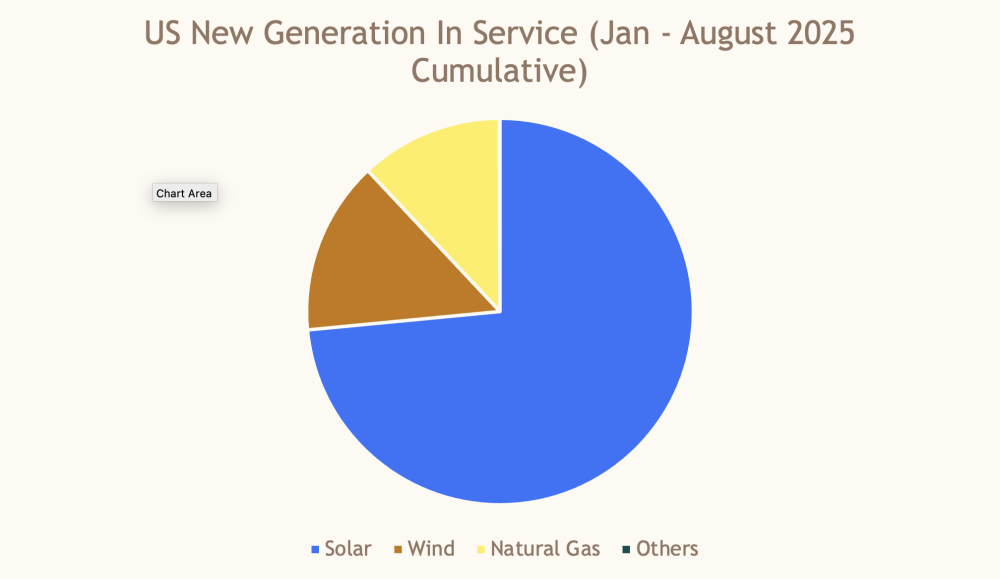
Despite the policy rollback, the decarbonization of the U.S. power sector is continuing. In February, as Trump resumed office, the U.S. Energy Information Administration predicted that over 90% of new utility-scale capacity additions would be renewables and battery storage. [2]

Despite the noise since then, the latest data to August from regulator FERC shows that solar and wind represented 88% of all new capacity additions. [3]

Source: FERC

This is not a blip—it’s a structural shift. Competitive costs and the rapid speed of deployment are driving a clean energy build-out that the latest policy reversal has not stopped.

What about gas and nuclear?

Both gas and nuclear will remain part of the long-term mix, but neither can scale quickly. For gas, while there is certainly more demand, a turbine order made today will not be online until the 2030s.

And while nuclear has seen strong interest, including from AI-linked names like Microsoft, Google, Meta and Amazon who want baseload carbon-free power, so far, we have mainly seen restarts of recently mothballed plants. New small modular reactors (or SMRs) remain a 2030s story.

Demand inflecting for the first time in 20 years

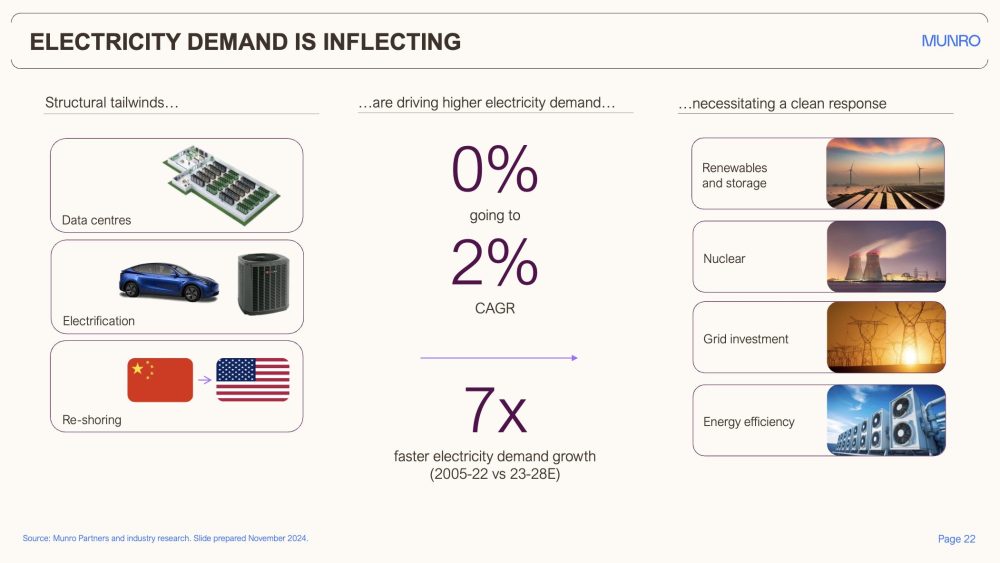
At the same time as supply is greening, demand is inflecting. After decades of flat growth, where new demand for electricity was offset by efficiency gains, today we’re seeing absolute demand rising.

Why?

We’ve observed three structural drivers:

  • Data centres and artificial Intelligence (AI): Data centres are power-hungry. By 2030, the IEA estimates that U.S. data centre demand will more than double to over 400 TWh, up from around 180 TWh in 2024. That’s more than what the whole of Poland consumes annually. [4]
  • Electrification: While electric vehicle adoption will slow due to new U.S. policy, it, together with electric heat pumps replacing gas boilers and industrial electrification, are adding load across sectors.
  • Reshoring from China: The Administration is incentivising industries to come back to the U.S., which bring with them energy-intensive processes.

In fact, we surmise that the U.S.’s strategic desire to lead in AI and to reshore from China explains why Trump’s policy rollback for renewables was more benign than anticipated. The Administration realises the U.S. needs all the electricity it can get.

The result: U.S. electricity demand is projected to grow much faster now than the last 2 decades. This presents a structural tailwind for utilities, grid and renewables developers, and service providers.

Source: Munro Partners and industry research. Information prepared November 2024.

So, who benefits?

There are many ways to invest in the ongoing structural greening of the U.S. grid and the recent inflection in demand. Quanta Services, a holding in our Global Climate Leaders strategy, is a prime example.

Quanta specialises in developing grid infrastructure and renewables projects. With nearly US$40bn in backlog and long relationships with major developers, the company is well positioned to capture increasing spending on the grid and renewables.

The Global Context: 195 minus One Doesn’t Equal Zero

Paris Agreement: U.S. exits, no one follows

In early 2025, President Trump again pulled the U.S. out of the 2015 Paris Agreement on climate change, but the global response was telling: like last time, no one followed. The other 194 signatories remain committed.

Today, even without the U.S., countries representing around three quarters of global GDP and emissions are committed to net zero.[5] In many cases, they are accelerating their efforts.

China’s 2035 Pledge: the same as fully decarbonizing Canada two times over

China remains the world’s largest emitter with an estimated 29% contribution to global emissions in 2024, according to the European Commission. [6]

With our newsfeeds centred around what was happening in the U.S., it was easy to miss China’s first absolute emissions reduction target announced in September: 7–10% below peak levels by 2035.

Critics argue this is modest, but scale matters: cutting 2024 emissions by 10% in China is equivalent to fully decarbonising Canada not once, but twice! [7]

Alongside this, China aims to raise non-fossil energy consumption to 30% and expand wind and solar capacity to 3,600 GW by 2035. Again, to get a sense of the scale, that’s more than three times the entire electricity generation capacity of the U.S. (at 2023 recorded levels). [8]

Again, this presents an enormous opportunity for the companies that will make this happen, and for their investors.

Energy Storage: The Backbone of China’s Greening Grid

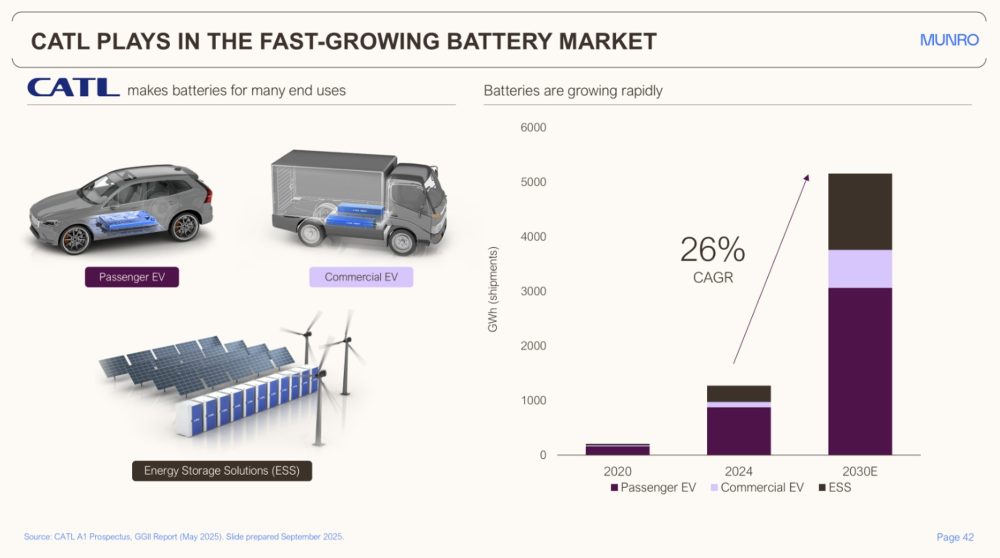
China’s renewable ambitions hinge not just on solar and wind but on energy storage solutions (or ESS). China needs ESS because much of the solar it has already installed is curtailed (essentially wasted) because supply exceeds demand.

To illustrate, in the first half of this year, 33% of the solar generated in the western Chinese region of Tibet was curtailed. If they had more ESS, they could store this excess supply during daylight hours and use it in the evening peak.

To address this, China recently announced ambitious ESS policies aiming to grow capacity by nearly 30% p.a. to 180GW by 2027, requiring investment of US$35b: a huge revenue opportunity for developers and battery makers. [9]

So, who benefits?

Contemporary Amperex Technology Limited (CATL), another Global Climate Leaders strategy holding, is riding this wave. A Chinese national champion, CATL holds the largest global market share — over a third — in batteries today. They now predict that the growth in batteries for ESS will outpace electric vehicles to the end of the decade.

Source: CATL a1 Prospectus, GGII Report (May 2025). Charts prepared September 2025.

Beyond the Noise

2025 has been a year of contradictions. The headlines scream rollback, but the reality on the ground whispers resilience and inflection.

In the U.S., the reality is that even today renewables are being deployed much more than fossil fuels. The dearth of cheap, fast-to-deploy and available alternatives, and the inflection in electricity demand, provide ongoing support.

Outside the U.S., we see decarbonization ambition is increasing. China’s aim to take two Canadas-worth of emissions out of its system by 2035 presents investors an opportunity to invest in – and benefit from – a generational transformation.

For those willing to look beyond the headlines, 2025 is not a setback for climate investing — it’s validation of a robust multi-decade structural growth opportunity.

Sources:

[1] NextEra Q3 2025 results presentation

[2] https://www.eia.gov/todayinenergy/detail.php?id=64586

[3] https://cms.ferc.gov/media/energy-infrastructure-update-august-2025

[4] Per Ember data https://ember-energy.org/data/yearly-electricity-data/

[5] https://zerotracker.net/

[6] https://edgar.jrc.ec.europa.eu/report_2025

[7] In 2024, Canada’s emissions were 768 mtCO2e, and 10% of China’s emissions was 1,554 mtCO2e https://edgar.jrc.ec.europa.eu/report_2025

[8] In 2023, the U.S. had 1,189 GW of generation capacity: https://www.eia.gov/energyexplained/electricity/electricity-in-the-us-generation-capacity-and-sales.php#:~:text=At%20the%20end%20of%202023,electricity%2Dgeneration%20capacity%20in%202023.

[9] UBS


RIA Disclaimer

The views and opinions expressed in this article are solely those of the authors and do not necessarily reflect the view or position of the Responsible Investment Association (RIA). The RIA does not endorse, recommend, or guarantee any of the claims made by the authors. This article is intended as general information and not investment advice. We recommend consulting with a qualified advisor or investment professional prior to making any investment or investment-related decision.