Plugging the Gap: Tackling Urban Environmental Challenges With Adaptation and Resilience Investment 

Houses washed away by floods, power lines and road surfaces buckling under extreme heat, and drought threatening food supplies and pressuring water resources. These natural disasters are becoming all too common. And they are taking a massive economic toll.

In 2024 alone, the world experienced more than 150 extreme weather events, causing an estimated USD320 billion in global economic losses – 40% higher than the decade-long annual average.

As the impact of climate change and environmental degradation increases, it is clear that investing in adaptation and resilience (A&R) – concrete steps such as enhancing grid resilience through advanced modelling and simulation, retrofitting existing buildings with efficient energy technologies or installing stormwater pump stations – becomes just as important as measures to mitigate global temperature rises.

Crucially, A&R investment is more than just about blunting the immediate impact of climate change while taking advantage of the potential for attractive return.

Companies that can meet the growing demand for climate change adaptation with the right business model and economics have a real chance to offer attractive investment opportunities.

Inflection point

Until now, adaptation has not been a magnet for investment.

The sector attracted just over USD30 billion in new capital in 2024, falling well short of hundreds of billions of dollars experts estimate are needed to mitigate the financial impact from climate change in the coming decades.

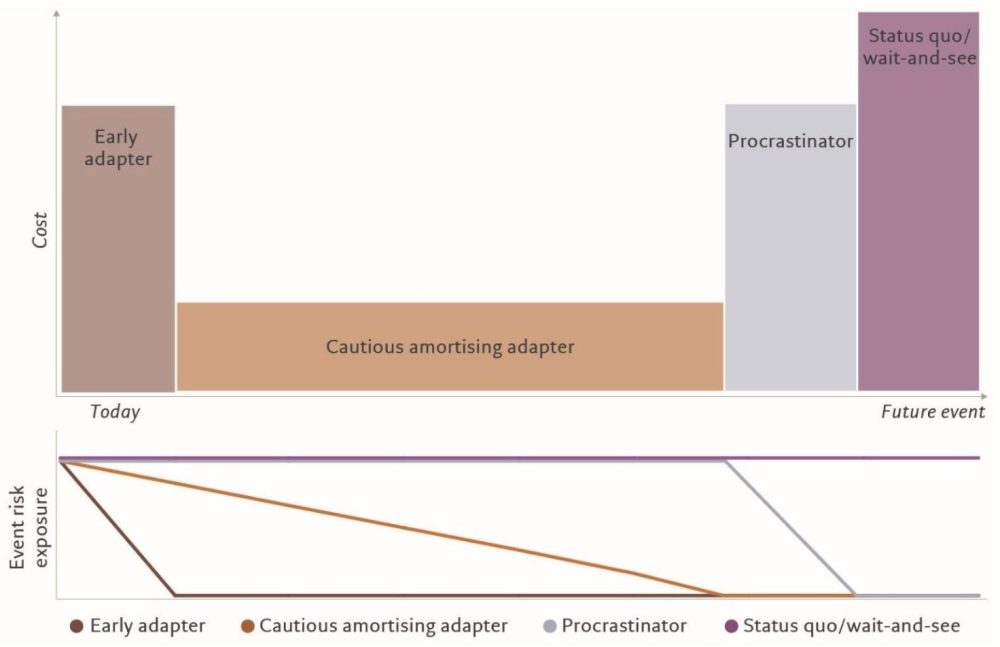
The lack of corporate commitment may be down to a potential dilemma or trade-off – the earlier you are, the more uncertainty there is. Corporates do not want to overspend on things they do not know and they tend to wait. But the longer you wait, the greater your exposure becomes to future risks.

Figure 1 – Adapter’s dilemma

Sample management approaches to climate adaptation
Source: JP Morgan, Building Resilience Through Climate Adaptation, 2025

Encouragingly, this gap is beginning to close.

According to a report by London Stock Exchange Group, 34% of large and medium-sized listed companies in the FTSE All World Index are already referring to adaptation measures in their annual disclosures.

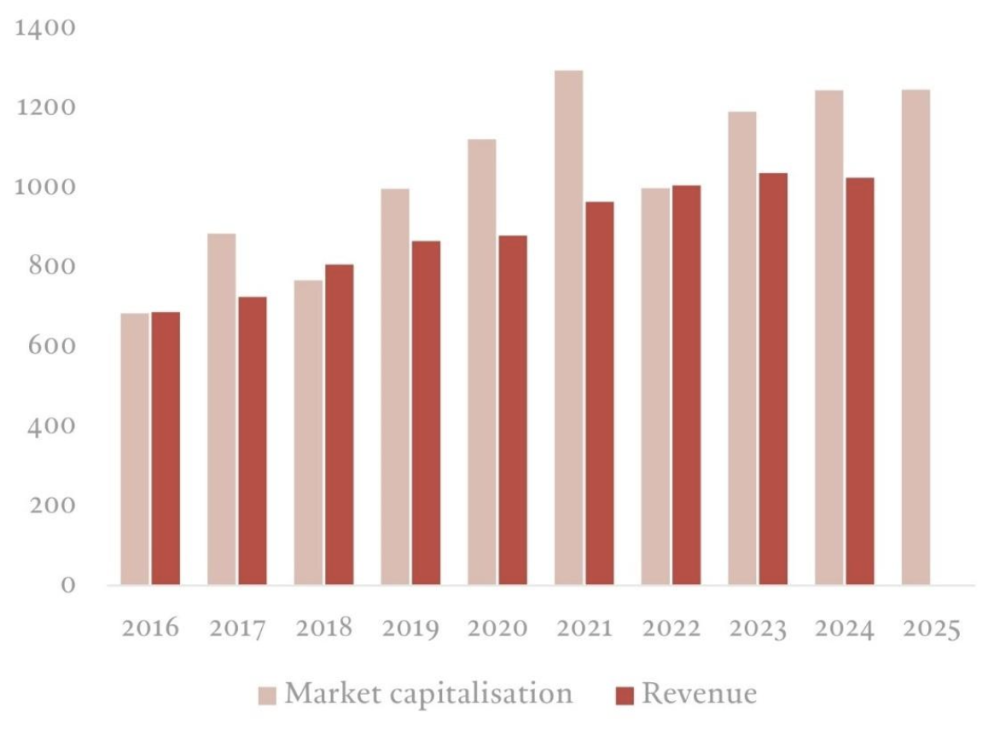
Corporate adaptation finance flows are growing at a four-year Compound Annual Growth Rate (CAGR) of 21% with companies who have embraced adaptation solutions generating over USD 1 trillion in green revenue last year.

Fig. 2 Adaptation and resilience growth and sectors

Market cap and revenue growth of adaptation and resilience industry (USD billion)
Source: LSEG, data as of 12.05.2025 

A conservative estimate from climate consultancy Tailwind assumes that if each of the 10,000 publicly listed companies spends just USD 50 million on climate resilience investments, the latent demand from corporations should be at least USD 500 billion annually. [1]

Technology companies are among the leading industries investing in A&R strategies. That is because extreme heat, drought and flood risks threaten their operations. 

Those building and operating data centres in arid regions like Arizona will need to consider investing in efficient cooling technologies, large solar panels, smart water management and recycling systems, as well as adopting sustainable and green building designs.  

These measures should not only mitigate drought and heat risks and ensure round-the-clock operations during extreme weather but also reduce emissions. By conserving energy and water, they will ease strain on local grids and water systems, on top of cutting utility bills. 

A study by the World Resources Institute (WRI) found that every USD 1 invested in A&R generates more than USD 10 in benefits over 10 years. This translates to potential returns of over USD 1.4 trillion, with average annual returns of 27%. Part of this will accrue directly to investors. 

Crucially, these benefits go beyond financial gains. The report also explained that A&R projects typically yield a “triple dividend,” providing an environmental and social return in addition to a financial one. 

The WRI study found that financial and non-financial gains from A&R projects are often equal in magnitude, yet only 8% of investment appraisals translate every benefit, financial and non-financial, into a single dollar figure. This suggests that societal rates of return are substantially underestimated in economic assessments of most adaptation investments. 

A&R investing therefore stands out as a powerful way to protect assets, unlock new sources of growth and capture attractive return potential while helping build a more climate-resilient economy for the decades ahead.


Sources

  1. Tailwind, Taxonomy for Climate Adaptation and Resilience Activities, 2024

RIA Disclaimer

The views and opinions expressed in this article are solely those of the authors and do not necessarily reflect the view or position of the Responsible Investment Association (RIA). The RIA does not endorse, recommend, or guarantee any of the claims made by the authors. This article is intended as general information and not investment advice. We recommend consulting with a qualified advisor or investment professional prior to making any investment or investment-related decision.

Weighing Canada’s LNG ‘Trilemma’

When the first ship set sail from the LNG Canada terminal on June 30, 2025, it marked a new era for Canada. This was the moment when we joined a handful of nations as exporters of Liquefied Natural Gas (LNG), a fuel source that has rapidly gained prominence in the new world energy order.

Canada’s entry onto the LNG stage raises some important questions:

  • How critical are LNG exports to helping Canada fulfil its energy leadership ambitions?
  • Is Canadian LNG the key to energy resilience and security for nations who have had their traditional natural gas supplies disrupted?
  • And especially important for responsible investors, can LNG become a ‘bridge fuel’ to renewables and a facilitator of long-term decarbonization of the world’s energy system?

The role of LNG in the future global energy mix

Rising interest in LNG is tied to steadily rising global demand for energy. Demand drivers include economic growth and industrialization in developing markets, the global shift to electrification of transport and heating, and the need to support the power demands of AI-driven data centres. The root driver, however, is population growth. Global population is expected to reach nearly 10 billion people by 2050, with a good chunk of that in the expanding urban centres of Asia and Latin America. LNG has a crucial role to play in responding to this demand. But to fully understand that role, LNG must be considered through the lens of what has been coined the energy ‘trilemma’: the three different and often opposing factors of affordability, security and sustainability.

LNG’s uneven sustainability advantage

Let’s begin with the most important consideration for the RIA’s audience: sustainability. Of all fossil fuels, natural gas is the cleanest burning, emitting about 45% less CO2 than coal. If reducing carbon emissions is the core goal, gas is an attractive option for coal replacement. In fact, in select regions where gas has replaced coal, system wide emissions have been reduced significantly.

Could expanded use of LNG help reduce carbon emissions globally? The Fraser Institute contends that if Canada were to double its current natural gas production and export the additional supply to Asia as LNG deployed as a direct and equivalent replacement of coal, global GHG emissions could be reduced by up to 630 million tonnes annually, a reduction equivalent to 89% of Canada’s total GHG emissions. With several countries set to significantly expand their LNG export capacity, the potential for GHG reductions is substantial. But it is potential only.

Answering the LNG bridge fuel question: it’s not so simple

Viewing LNG solely through a sustainability lens ignores the fact that the world doesn’t just need more LNG, it needs more energy from all sources. That’s just one challenge to the ‘bridge fuel’ thesis. A second is estimating just how long that bridge needs to be: too long would increase dependency on natural gas and LNG, potentially reducing investment in renewable energy sources. Additionally, natural gas and LNG are not equal: processing LNG adds considerable emissions beyond those occurring in the traditional natural gas supply chain. Furthermore, methane leakage (methane is both the primary constituent of natural gas and the second most significant greenhouse gas, with a potential impact on global warming that is 28 times greater than that of carbon dioxide over a 100-year period) is especially pronounced with LNG. Produced through a series of separate systems, LNG presents multiple opportunities for methane leaks. Although these risks can be managed, they cannot be eliminated.

Is LNG secure and affordable?

Which brings us to considerations of energy security and affordability. Europe is considered a strong market for LNG, despite the EU’s longstanding climate commitments. Yet it is security considerations that now dominate the energy agenda, as they increasingly do across all regions in our disrupted world. The two factors are complementary. Expanded renewable energy reduces the need for natural gas, reinforcing Europe’s principle to avoid dependence on energy it doesn’t have – the very definition of energy security. [1]

The far more promising market is Asia, where LNG consumption is predicted to double by 2050, driven by economic growth and limited access to pipeline-delivered natural gas. But applying the LNG trilemma in Asian markets is complex. China is both the world’s biggest coal user and the world leader in renewable energy. And in other markets, such as India, shifting away from coal may not even be a practical option. Many countries in Asia are also opportunistic buyers of energy based on price, which diminishes the importance of sustainability factors in energy buying decisions. [2]

The potential impact of a rapidly expanding global LNG supply

Against this backdrop, the global LNG industry is expanding rapidly, with plans to add almost five times as much new liquefaction capacity from 2025 through 2028 compared to the previous four-year period. This rapid expansion presents an obvious saturation risk, with the IEA projecting a supply overhang that could “depress international gas prices and set the stage for fierce competition between suppliers”. It is unclear whether demand will be enough to close that gap, especially with anticipated advancements (and cost reductions) in renewable technologies and battery storage.

The cold reality of Canada’s LNG ambitions

So, what does this mean for Canada? It took a long and contentious 15 years to take the inaugural LNG Canada facility from licensing and permitting to shipping the first tanker-load of LNG. Over the same period, the U.S. alone constructed LNG export facilities totaling eight times the exporting capacity of LNG Canada. Canada may have geographical advantages, may produce its LNG with a lower carbon footprint, and LNG may (if methane is managed properly) produce emissions significantly lower than thermal coal, but buyers will weigh affordability, security and sustainability factors unevenly and dynamically.

To win in LNG, Canada will need demand for all types of energy to continue to spike (especially in Asian markets where Canada holds a geographic advantage for shipping LNG) and be able to accelerate building LNG infrastructure to meet this need. Given LNG’s history in Canada, the latter is far from certain. Additionally, unaddressed here in detail, but an essential consideration is the consent and participation of Indigenous peoples in Canada’s LNG plans. Responsible investors must also consider the implications of a potential time-mismatch: when LNG assets built with a 30- to 50-year lifespan intersect with the anticipated rapid integration of renewables, stranded assets become a significant risk.

In short, LNG is no slam dunk. But, after the lengthy delays that brought Canada late to the LNG party, the first ship, laden with a promise far weightier than its cargo, has finally sailed. Canada is now officially in the LNG game.


References

  1. Interview with Luke Sussams – Jefferies
  2. Interview with Baltej Sidhu – National Bank

Disclosure

The content of this article (including facts, views, opinions, recommendations, descriptions of or references to, products or securities) is not to be used or construed as investment advice, as an offer to sell or the solicitation of an offer to buy, or an endorsement, recommendation or sponsorship of any entity or security cited. Although we endeavour to ensure its accuracy and completeness, we assume no responsibility for any reliance upon it. This article may contain forward-looking information which reflect our or third party current expectations or forecasts of future events. Forward-looking information is inherently subject to, among other things, risks, uncertainties and assumptions that could cause actual results to differ materially from those expressed herein. These risks, uncertainties and assumptions include, without limitation, general economic, political and market factors, interest and foreign exchange rates, the volatility of equity and capital markets, business competition, technological change, changes in government regulations, changes in tax laws, unexpected judicial or regulatory proceedings and catastrophic events. Please consider these and other factors carefully and not place undue reliance on forward-looking information. There should be no expectation that such information will in all circumstances be updated, supplemented or revised whether as a result of new information, changing circumstances, future events or otherwise.

RIA Disclaimer

The views and opinions expressed in this article are solely those of the authors and do not necessarily reflect the view or position of the Responsible Investment Association (RIA). The RIA does not endorse, recommend, or guarantee any of the claims made by the authors. This article is intended as general information and not investment advice. We recommend consulting with a qualified advisor or investment professional prior to making any investment or investment-related decision.

Investing in the Evolving Energy Transition

The global energy transition is entering a new phase. Falling clean-technology costs, rising electricity demand and advances in electrification are reshaping where and how the transition is taking place. And while policy support and climate commitments remain important, the primary drivers of decarbonisation are shifting toward economics and technology.

Two dynamics are particularly important. First, emerging markets have become the growth engine of the energy transition – largely because clean technologies are now often the lowest-cost option for new power generation and industrial development. In advanced economies, a sharp acceleration in electricity demand, largely due to AI, is creating renewed urgency to add more power sources, upgrade the grid and use energy more efficiently in everything from semiconductor workflows to data-centre cooling.

Together, these trends are redefining the opportunity set for investors across the energy transition value chain.

Fundamentals versus sentiment

In recent years, investor sentiment toward clean-technology sectors has been depressed. Higher interest rates and uncertainty over government support weighed on company valuations. However, weakening sentiment has not been matched by a deterioration in fundamentals. Many high-quality companies enabling decarbonisation have continued to deliver strong earnings growth.

The gap between earnings performance and share-price performance has created a notable disconnect, particularly among companies with durable competitive advantages and exposure to structural growth trends.

More recently, clean-tech markets have begun to recover. While some of this rebound reflects a technical recovery from oversold levels, we think there is a strong case that select companies in the decarbonisation universe are on track for durable growth.

This is partly because the market for their products and services is expanding rapidly: the International Energy Agency (IEA) projects that global clean-technology markets could more than triple in value by 2035, reaching over US$2 trillion annually, supported by continued cost declines and rising demand for electricity and efficiency solutions.

Emerging markets as the new growth engine

Emerging markets are increasingly at the centre of the energy transition. Unlike earlier phases which were largely driven by climate policy, clean-tech adoption in many developing economies is being led by cost competitiveness. Solar, wind, batteries and electric vehicles have reached – and in many cases surpassed – cost parity with fossil-fuel alternatives. This is broadening the decarbonisation investment opportunity set across the developing world.

China plays a critical role in this shift. Its scale and manufacturing efficiency have driven down global clean-technology costs. It is estimated to cost at least 40% more to manufacture solar panels, wind turbines and batteries in the US and Europe than in China, and up to 25% more in India. Consequently, Chinese exports of clean technologies are enabling countries across Asia, Latin America and Africa to electrify and industrialize more affordably.

Nearly half of China’s clean technology exports now go to emerging markets, to countries such as India, Brazil and Thailand. According to the IEA, China’s clean-technology exports could exceed US$340 billion annually by 2035.

Rising power demand in developed markets

At the same time, developed markets are experiencing a structural shift in electricity demand. After decades of relatively flat consumption, power usage in the US and Europe is surging. Key drivers include artificial intelligence, data centres, electrified heating and cooling, electric vehicles and some degree of industrial reshoring. In the US, electricity consumption is expected to grow by approximately 38% over the next two decades, compared with just 9% growth over the previous 20 years.

This surge has elevated the importance of utilities, grid operators and efficiency specialists. Access to reliable, affordable power has become a critical constraint for data centre developers and industrial users, with major technology companies increasingly citing electricity availability as a bottleneck to expansion.

Utilities that can deliver low-cost renewable generation, invest in grid modernisation and manage rising demand are therefore well positioned for growth, as are companies that provide efficiency solutions for computing and industrial processes.

Technology, electrification and efficiency

Technological progress is also broadening decarbonisation markets. Today, more than 75% of final energy demand is considered technically electrifiable. This creates significant opportunities across industrial electrification, power semiconductors and energy-management technologies.

Efficiency is an equally important lever. As electricity demand rises, reducing energy intensity becomes critical to limiting emissions growth and infrastructure strain. Technologies that enable smarter energy use – from power-efficient data-centre hardware to advanced industrial automation – will play a central role in this next phase of the transition.

Beyond energy systems, innovation is also emerging in sectors such as agriculture. Food systems account for roughly 30% of global greenhouse-gas emissions, and precision-agriculture technologies offer pathways to improve productivity while reducing environmental impact.

Implications for investors

For investors, this “transition of the transition” – from policy-driven to economics-driven adoption, and from developed-market leadership to emerging-market acceleration – underscores the important of focusing on fundamentals rather than short-term sentiment. As decarbonization becomes more closely linked to cost efficiency and technological progress rather than policy, the next phase of the energy transition may prove broader, faster and more resilient than markets currently assume.


RIA Disclaimer

The views and opinions expressed in this article are solely those of the authors and do not necessarily reflect the view or position of the Responsible Investment Association (RIA). The RIA does not endorse, recommend, or guarantee any of the claims made by the authors. This article is intended as general information and not investment advice. We recommend consulting with a qualified advisor or investment professional prior to making any investment or investment-related decision.