How Active Investment in Traditional Corporate Bonds Can Deliver Significant Social Change

There is no question that society expects the investment industry and capital markets to responsibly allocate capital to help solve some of our biggest challenges. While equity investors may have the higher profile due to their ability to influence company behaviour through engagement and proxy voting, the corporate bond market is critically important to both raising capital and impacting strategy.

Generally, corporations tend to issue corporate bonds as a form of borrowing more often than equity issuance. As a result, corporate management teams are frequently reaching out to credit investors to convince them to buy their bonds. Although credit investors don’t vote proxies, they can be a key driver of positive change.

We’ve recently seen the rise of different forms of ‘responsible’ bonds – Green, Social, Sustainability-Linked and others – which would appear to fulfill that need to make a positive difference. Responsible bonds certainly do drive positive change, but there is a strong argument that there is a significantly higher potential impact from traditional bond buyers who actively engage with companies and push for change.

Responsible bonds – a quick primer

With ESG considerations gaining more and more prominence in global capital markets, institutional investors, together with their clients and beneficiaries, continue to demand more corporate action to address those issues. One key development has been the creation of corporate bonds with covenants requiring certain favourable ESG-linked behaviours.

Original forms of responsible bonds, such as Green and Social bonds, include covenants setting out a specific set of investments that the bond proceeds must be used for. This helps ensure investors that they have driven change as the raised capital will be used for beneficial projects. Green and Social bond issuance continues to grow globally, a trend that will hopefully continue.

Taking a broader perspective on influencing corporate strategy

The influence of Green or Social bonds only extends to the specific proceeds from their issuance, which can limit their impact on corporate behaviour. For example, a coal-fired power producer with $20bn of overall debt might issue a $500m green bond to invest in one small wind turbine, driving a relatively small improvement within its overall business. Meanwhile, the proceeds from its larger, traditional bonds help maintain “business as usual.”

If active fundamental credit investors in that $20bn of traditional debt elect to engage with company management they have a powerful platform to promote responsible change to overall corporate strategy.

Though perhaps an extreme example, in reality most one-off Green or Social bond issues tend to be a small part of the issuer’s overall financial profile.  While green and social bonds can be a source of positive change, the potential impact from engaged buyers of traditional bonds can be far greater.

Sustainability-Linked Bonds – an innovative solution

Recently we’ve seen the rise of Sustainability-Linked Bonds (SLBs), which include covenants that create an incentive for a company to meet defined corporate level performance metrics, by including a step-up in the cost of the debt if the performance metric is not achieved. With Green or Social bonds, the impact is limited to the proceeds from the one bond issue; in comparison, SLBs have the potential to directly impact overall corporate behaviour and targets. Although SLBs are relatively new and there has been limited SLB issuance to date, they represent an exciting innovation that provides credit investors with another important tool to enact change.

With more issuance we’ll see just how committed companies are to setting and meeting demanding targets for performance improvement. Ultimately, as the SLB market grows, it will be important for active investors to continue to engage with companies to hold them accountable and ensure that any performance metrics are both tangible and relevant. Allotting outsized importance to one or two metrics may provide an incomplete picture of overall corporate behaviour and direction.

Metrics can also be gamed. Using our coal-fired power producer example, the company could issue an SLB and commit to reducing the carbon emissions intensity of its revenue, accomplishing that by buying another wind power company. Its emissions intensity will decrease, but society is no better off with overall emissions staying the same.

However, if a renewable power company buys a coal-fired power plant with plans to convert the facility to a more sustainable form of power generation, their overall carbon emission intensity may increase in the short run, but society actually benefits from lower overall carbon emissions over time. In this instance, providing debt funding through a traditional bond would reduce more carbon emissions for society than buying the SLB of the coal-fired power company that just used M&A to game its metric.

Active investors that look beyond SLBs and just one or two metrics will have the ability to provide capital funding for a wider variety of solutions to society’s challenges.

Looking towards the future

The various forms of responsible bonds will likely continue to evolve and their issuance will remain a growing source of positive influence in society.  However, realizing the full potential of the corporate bond market to drive change will require active fundamental credit investors that engage with companies and use their buying power in traditional bonds to influence corporate strategy.
RIA Disclaimer
The views and opinions expressed in this article are solely those of the authors and do not necessarily reflect the view or position of the Responsible Investment Association (RIA). The RIA does not endorse, recommend, or guarantee any of the claims made by the authors. This article is intended as general information and not investment advice. We recommend consulting with a qualified advisor or investment professional prior to making any investment or investment-related decision.

What Investors Need Most from COP26: Useful Data to Inform Decision-Making

Currently, delegates from hundreds of countries, leaders of business and finance, and policymakers from across the world are in Glasgow for the COP26 climate conference. There they aim to accelerate action to reduce global greenhouse gas emissions to net-zero by the middle of the century.

Among the goals of COP26 is to spur sustainable investment on a scale required to remake how the world produces and consumes energy, a change that will demand the largest reconstruction of the global economy since the Industrial Revolution. The latter transition took roughly 80 years. The world needs to reach net-zero in less than half that time.

It’s time for companies and capital-markets participants to seize the moment offered by COP26 to commit to net-zero across their businesses and portfolios. The Paris Agreement, which rests on a commitment by countries to prevent the worst effects of climate change by keeping global warming this century to well below 2°C, preferably 1.5°C, provides precedent for action.

As we look to what will be achieved at COP26 and beyond, here are three items that support the rechanneling of capital at the speed that reaching net-zero by 2050 will demand.

Stress the need to make net-zero a central part of business strategy

The net-zero revolution will reach every corner of our economy and society. It won’t be enough for today’s companies to focus solely on reducing their dependence on fossil fuels. Over the next decade, companies will need to invent solutions and services that replace existing business models.

Companies also will need to redouble their efforts to reach net-zero. At present just over a third of the world’s listed companies have set some type of target to decarbonize. Fewer have announced plans to cut emissions to net-zero. Some of the world’s largest corporate emitters of greenhouse gases have yet to report any of their emissions.

In the nearly six years since the Paris Agreement was signed, governments around the world have introduced a range of plans and initiatives, but the planet won’t achieve its climate target without net-zero commitments becoming a central part of business strategy. For the net-zero revolution to succeed, it needs to ignite bold action by companies to drive emissions down across their businesses – not best efforts but verifiable commitments backed by continuous progress toward net-zero goals.

Providers of capital must commit too. Investors must put their portfolios on a path to net-zero while banks should adjust their practices and align their lending with a 1.5°C world. For our part, MSCI has committed to being net-zero before 2040 and will team with the Glasgow Financial Alliance for Net-Zero to spearhead an alliance of financial service providers to supply market infrastructure that supports sustainability.

To ensure accountability and transparency, the COP26 conference should seal the global adoption of frameworks such as the Task Force on Climate-related Financial Disclosures for taking climate risk into account in developing strategic plans and priorities. For investors and other stakeholders, such disclosures provide critical insight into how a company may be helped or hurt by a net-zero economy.

Mandate a set of quantitative climate disclosures

Investors need quantitative data that allows them to assess the resilience to climate change of every asset, so they can value both risks and opportunities across their portfolios. Much of that information should come from companies, and much of it isn’t disclosed today.

The decarbonization targets that companies do set vary by the business activities they cover, feasibility and timeline. Some banks, for instance, have yet to report emissions from the projects they finance; this is a category that contributes the largest portion of their carbon footprint. The variety and gaps leave investors struggling to assess the potential impact of targets on the climate risks companies face.

COP26 should encourage policymakers to introduce mandatory climate-related disclosures based on internationally agreed-upon standards that incorporate specific units of measurement. At a minimum, such standards, which companies should commit to adopting, should call for companies to disclose their complete carbon-emissions footprint, the location of their largest facilities and the emissions of their largest suppliers.

If companies disclose a common, core set of climate data, investors will converge on the information they need to inform their decision-making.

Up the urgency

The middle of the century remains nearly 30 years away, but long-term investment managers need to begin decarbonizing their portfolios today as the reallocation of capital and repricing of assets is already underway.

That creates the potential for scarcity. Without a redoubling of efforts by companies to cut emissions, investors who try to align their portfolios with a world that keeps global warming to 1.5°C by the end of the century may find themselves short of investable options.

COP26 can counter that by affirming the need for all companies to set emissions-reduction targets covering both their direct and supply-chain emissions, as well as those caused by use of their products. The targets should aim to keep companies well under the net-zero budgets for their industry sector by no later than 2050.

By MSCI’s calculation, more than 90% of the world’s companies are not on track to lower their emissions enough for keeping global warming to 1.5°C. At their current rate of emissions, those companies would burn through their collective share of the global emissions budget for holding warming to that level in less than six years.

To avoid breaching a 1.5°C threshold, every listed company would, on average, need to reduce its carbon intensity by 10% each year until 2050. Yet historically fewer than one in four companies have managed to reduce their emissions by quite this much.

To create the net-zero future we want, we need to catalyze investment now. Investors need to be able to measure the carbon footprints of the companies they would invest in. Companies that aim to create and innovate need capital. And we all need to build a more sustainable world.

Contributor Disclaimer
Certain content ©2021 and reproduced by permission of MSCI ESG Research LLC; all rights reserved. The ESG data contained herein is the property of MSCI ESG Research LLC, its affiliates and/or information providers (“MSCI ESG”). Translation from English provided by RIA Canada. MSCI ESG makes no warranties with respect to any such ESG data or translation. The ESG data contained herein is used under license and may not be further used, distributed or disseminated without the express written consent of MSCI ESG.
RIA Disclaimer
The views and opinions expressed in this article are solely those of the authors and do not necessarily reflect the view or position of the Responsible Investment Association (RIA). The RIA does not endorse, recommend, or guarantee any of the claims made by the authors. This article is intended as general information and not investment advice. We recommend consulting with a qualified advisor or investment professional prior to making any investment or investment-related decision.

Is Say-on-Climate Here to Stay? It’s up to Investors

The pressure is on companies, and boards specifically, to enhance transparency on their strategies to mitigate climate risks and sustain their businesses in a net zero future. 2021 will be seen as a turning point where climate resolutions began receiving record support from investors. With 26 climate-related resolutions on the ballots this year, an astounding 14 earned majority support.

And investors can go beyond climate-targeted shareholder resolutions to raise climate concerns with the board. NEI Investments, for example, has a policy of voting against the chair if we feel the company is not adequately managing its climate-related risks. We follow up with the company after the AGM to explain our rationale and ensure our vote doesn’t get lost in the mix. But that is the challenge with voting against directors due to climate-related concerns; while voting to remove a sitting director is arguably one of the strongest actions you can take, the clarity of the message can get lost among the myriad reasons we vote against directors.

That is where the Say-on-Climate campaign comes in.

What is a Say-on-Climate?

The Say-on-Climate campaign was spearheaded by the Children’s Investment Fund (TCI) with As You Sow and the Australasian Centre for Corporate Responsibility (ACCR). Companies targeted by a “Say-on-Climate” proposal are asked to offer an annual advisory vote on their transition plan to a net zero economy. Investors are then tasked with assessing the strength of the company’s strategy to reduce emissions and align with the goals of the Paris Agreement – and to vote for or against the plan.

Several leading companies agreed to go straight to putting their climate action plans to a vote in 2021. Unilever, Moody’s, and Shell chose this route. These management-sponsored proposals received overwhelming support, nearing 90% and upwards.* On the other hand, shareholder proposals targeting other, less proactive companies to adopt a Say-on-Climate received an average support of just 25%. Investors seem wary about requiring companies to adopt this new practice, whereas they emphatically support companies that are proactively taking steps on this front. While these results don’t necessarily reflect future trends, they raise questions about what the future holds given the likelihood more companies will be targeted by the Say-on-Climate campaign.

The intended benefits – and cautions – of Say-on-Climate

Mitigating the risks of climate change requires urgent action. We commend those companies that did not shy away from putting forward their climate transition plan on their ballots, especially in this early stage where only a few companies have started to adopt this practice. Transparency is key. A growing Say-on-Climate practice should promote transparency and could pressure companies that have been slow to detail their strategies.

However, we are wrestling with potential unintended consequences related to this emerging practice. Voting for transparency is not the same as voting on the quality of a company’s climate plan. Are investors equipped to vote effectively on each and every climate action plan? And will this discourage investors from holding the board directly responsible for its oversight role on climate? Is it not the role of the board to set the strategy, and the role of investors to toss the board, if they don’t like the job they are doing – not ask them to pass their oversight responsibilities to investors? And most vexing of all, will it follow the path of say-on-pay votes and result in only the most egregious cases getting voted down? The binary nature of the vote means there is little room for nuance in assessing plans.

It is up to investors to decide whether Say-on-Climate is here to stay

What can we as investors do to make Say-on-Climate an effective tool to address climate concerns? Below are some key areas we believe we should consider and discuss.

  • Frequency: Is an annual advisory vote optimal when real transition plans will play out over years, not months? A longer voting cycle might give investors enough time and space to effectively assess progress and engage companies on areas of concern, while also giving companies enough space to make meaningful changes that are long-term in nature.
  • Balancing transparency against content: While companies choosing to be transparent should be commended, simple transparency is not the goal – a robust climate strategy is. Investors will need to balance those two elements and reflect that in their voting.
  • Accountability: Should the board or specific committee members be automatically voted down if a climate plan is poor? Or should there be an escalation process for particularly egregious plans? The benefit of the advisory vote might be to provide investors a way to distinguish between an unsatisfactory plan and a governance failure, where the latter requires votes against directors.
  • Engaging the proxy advisors: Proxy advisors will inevitably play a key role in influencing vote results if Say-on-Climate becomes common practice. Many investors will not have the resources to assess a large number of complex action plans. They will need to rely on proxy advisor research. As such, investors need to ensure that proxy advisors use a robust and transparent framework for their assessment.
  • Explain your vote: A vote number without context can send the wrong signal to a company. Investors need to follow up with companies to explain their rationale, especially in cases where a vote in favour of a climate plan represents only directional approval and does not necessarily indicate all aspects of the plan are fine.

As with just about everything ESG-related, the devil is in the details. Say-on-Climate is not a panacea and should be rolled out with care; but as long as investors stay focused on keeping the board accountable for a robust climate strategy, it could be a very useful tool for ensuring companies meaningfully address their future climate risks.

*Based on NEI review of the voting results of 14 companies
RIA Disclaimer
The views and opinions expressed in this article are solely those of the authors and do not necessarily reflect the view or position of the Responsible Investment Association (RIA). The RIA does not endorse, recommend, or guarantee any of the claims made by the authors. This article is intended as general information and not investment advice. We recommend consulting with a qualified advisor or investment professional prior to making any investment or investment-related decision.

A Focus on the ‘S’ in ‘ESG’: Standard Setting to Avoid Impact Washing in Affordable Housing Investment

There have been encouraging changes in the impact investing market as it matures, with asset owners and fund managers now paying more attention to the ‘Social’ or ‘S’ in ESG, expanding from the initial more limited focus on environmental sustainability (the ‘E’).

One social issue which intersects both social and environment categories and has taken on increasing pan Canadian prominence is the structural undersupply of affordable housing. The need for more affordable housing has been well documented in Canada, with housing 34 percent more expensive than median income household earnings and the largest cities in Canada topping the list of the least affordable in North America. Less firmly articulated have been tangible solutions, and specifically the imperative role of private capital, in tackling the housing crisis.

A growing market

This is a global issue, not just a Canadian one, and what we can learn from looking abroad is that impact investing is a critical part of the solution. There’s a significant need for private capital to help respond to this supply shortage through both debt and equity models.

Investor interest is expanding, and capital is beginning to flow at pace in other parts of the world. For example, investment into affordable housing funds has been the largest contributor to the growth of the social impact investment market in the UK, making up 42% of the market which is estimated to be worth £5.1 billion ($6.7 billion). Many of the funds emerging provide equity-like finance to acquire or develop properties through lease-based structures. This is one part of the solution to the UK’s housing affordability problem where there is a housing shortage of 60,000 homes/year and where, like Canada, home prices have soared in recent years.

Financing from UK government agencies, as co-investors in the funds rather than simply their traditional grant funding role, has been a helpful signal of support as the UK market matures. The fund management landscape is also evolving; fund managers, once specialist impact managers, now include some of the leading global asset managers, launching funds to provide affordable and specialist housing as well as housing to address homelessness, many with aspirations of raising hundreds of millions.

The amount of institutional investment flowing into this sector is due to the strong financial case for affordable housing funds: portfolio diversification, long-term index-linked income, combined with the significant demand for private capital.

What are we seeing in Canada?

CMHC has the ‘aspirational goal’ of eliminating housing need by 2030. While efforts have increased towards this end, for example CMHC’s Affordable Housing Innovation Fund and New Market Funds’ own affordable housing funds, we are only now starting to see the investor appetite in Canada that has emerged in the UK, despite a similar scope of problem and opportunity set.

Impact investment into affordable housing in Canada is of course not new, but there remain few funds that commit to delivering affordable housing in perpetuity based on community needs, working in partnership with local housing stakeholders. This community partnership approach is essential to investing in housing which works over the long-term.

Barriers to scaling up impact investment into affordable housing in Canada

Most ‘affordable housing’ in Canada is provided via mandates to private developers as part of larger, market-rate developments. The types of housing delivered through these developments is often limited to smaller, one-bedroom and studio units, unsuitable for the many families in need of affordable homes.

Additionally, the tenure length where affordability is limited to 10-20 years is inadequate because once that initial period expires, the housing often reverts to market rate, leading to security of tenure issues and impact loss over time. To make a sustainable impact, affordability should ideally be in perpetuity, built into lease and partnership agreements from the outset.

What we mean by ‘affordable’ also needs to be refined. While the standard definition links affordable rents to market rents, with growth of market rents consistently outpacing growth of incomes, affordability decreases over time. A more appropriate measure of affordability would be income-based, setting affordable rents at a maximum proportion of median net household incomes, adjusted for geography and number of bedrooms.

Lastly, there are secondary issues like housing investment activity inflating property valuations, unintentionally pricing out the beneficiaries that investors like public pension plans serve. These negative impacts need to be better understood and reported on as the sector grows.

Many of the above challenges are not unique to Canada. We can again look to social investment markets that have had a head start to avoid pitfalls and ensure that as the market here continues to grow, quality and suitability of the housing being delivered, and impact integrity, are at its core.

Standardizing impact management approaches

Accompanying the rapid market growth in the UK has been questions and inconsistencies about the way that impact is measured, monitored and reported. While many fund managers and housing providers have developed positive partnerships, there is not always transparency around the risk and return characteristics of investments or honesty about the impact additionality – that is, the actual impact that is achieved – from any given investment.

One initiative recently launched in the UK to help tackle these issues brought together leading fund managers to develop a common impact reporting approach for equity investment into affordable housing.  The purpose of the project is to set common reporting standards, mitigate negative risks, and encourage investment flows that make a positive difference on the supply and quality of affordable housing over the long term.

As the Canadian market evolves, similar ground rules will need to be established to set standards and ensure that incentives are aligned. This will help investors better navigate the social investment market and assess good opportunities from bad, encouraging as much capital as possible to flow towards delivering the genuinely affordable housing Canada so urgently needs.

RIA Disclaimer
The views and opinions expressed in this article are solely those of the authors and do not necessarily reflect the view or position of the Responsible Investment Association (RIA). The RIA does not endorse, recommend, or guarantee any of the claims made by the authors. This article is intended as general information and not investment advice. We recommend consulting with a qualified advisor or investment professional prior to making any investment or investment-related decision.

Environmental Measures in Executive Compensation in Canada’s Extractive Industry: 3 Target-Setting Approaches

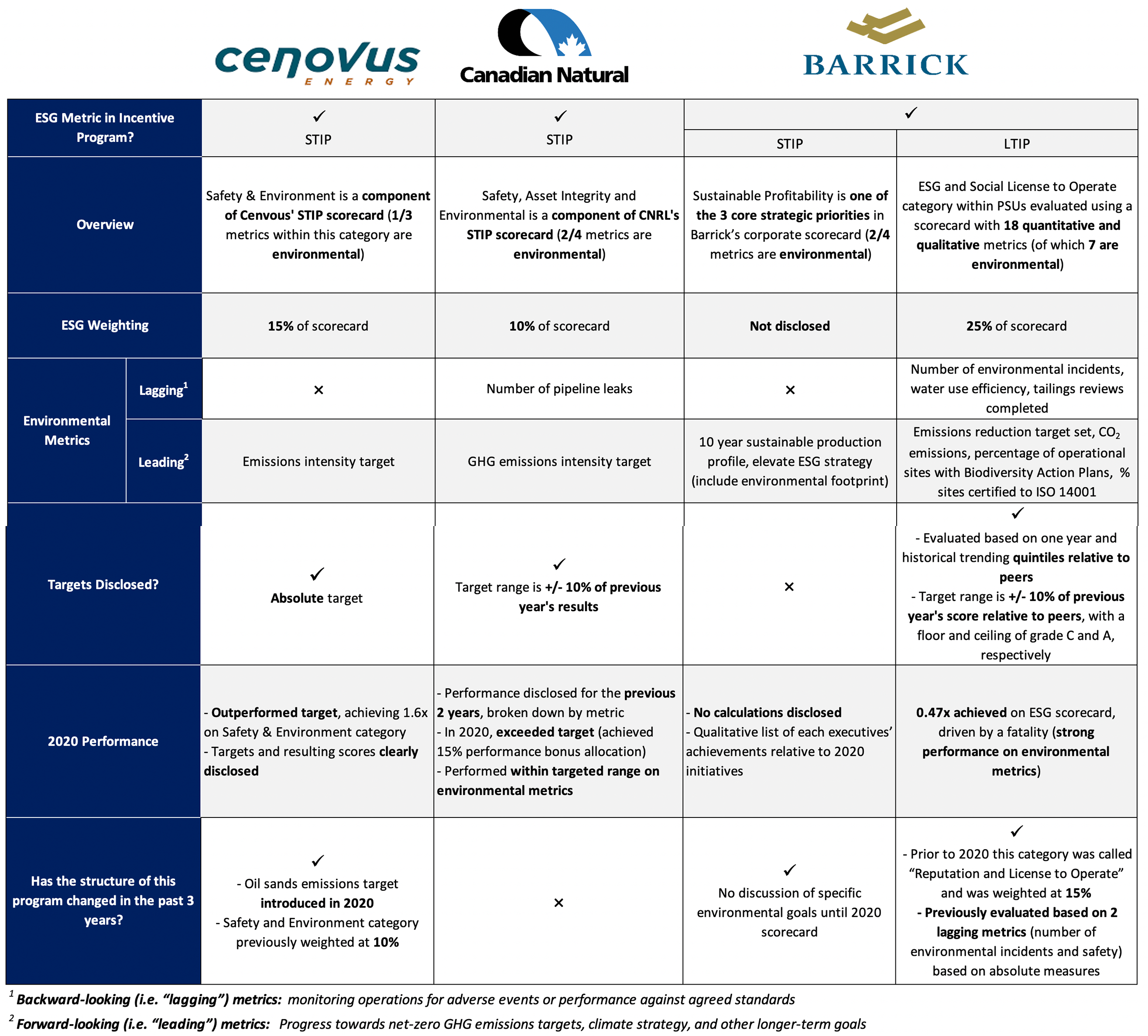
Many of Canada’s largest extractive companies have set ambitious environmental goals with long-term horizons (e.g., 2040 or 2050 net zero goals). One tangible way for companies to incentivize progress and demonstrate commitment to their environmental goals is by tying executive pay to specific climate metrics. This is becoming an increasingly common practice for Canadian companies, with 23% of TSX60 companies incorporating environmental metric/s into compensation[1]. This article provides case studies of how 3 organizations that have each made 2050 net zero commitments[2],[3],[4] incorporate environmental measures into their incentive programs using the following target-setting approaches:

  • Absolute target (e.g., discrete numerical target set each year)
  • Relative year-over-year target (e.g., target range relative to previous year’s results)
  • Target positioning relative to peers (e.g., target ranking relative to peers)

Cenovus Energy – Absolute Target

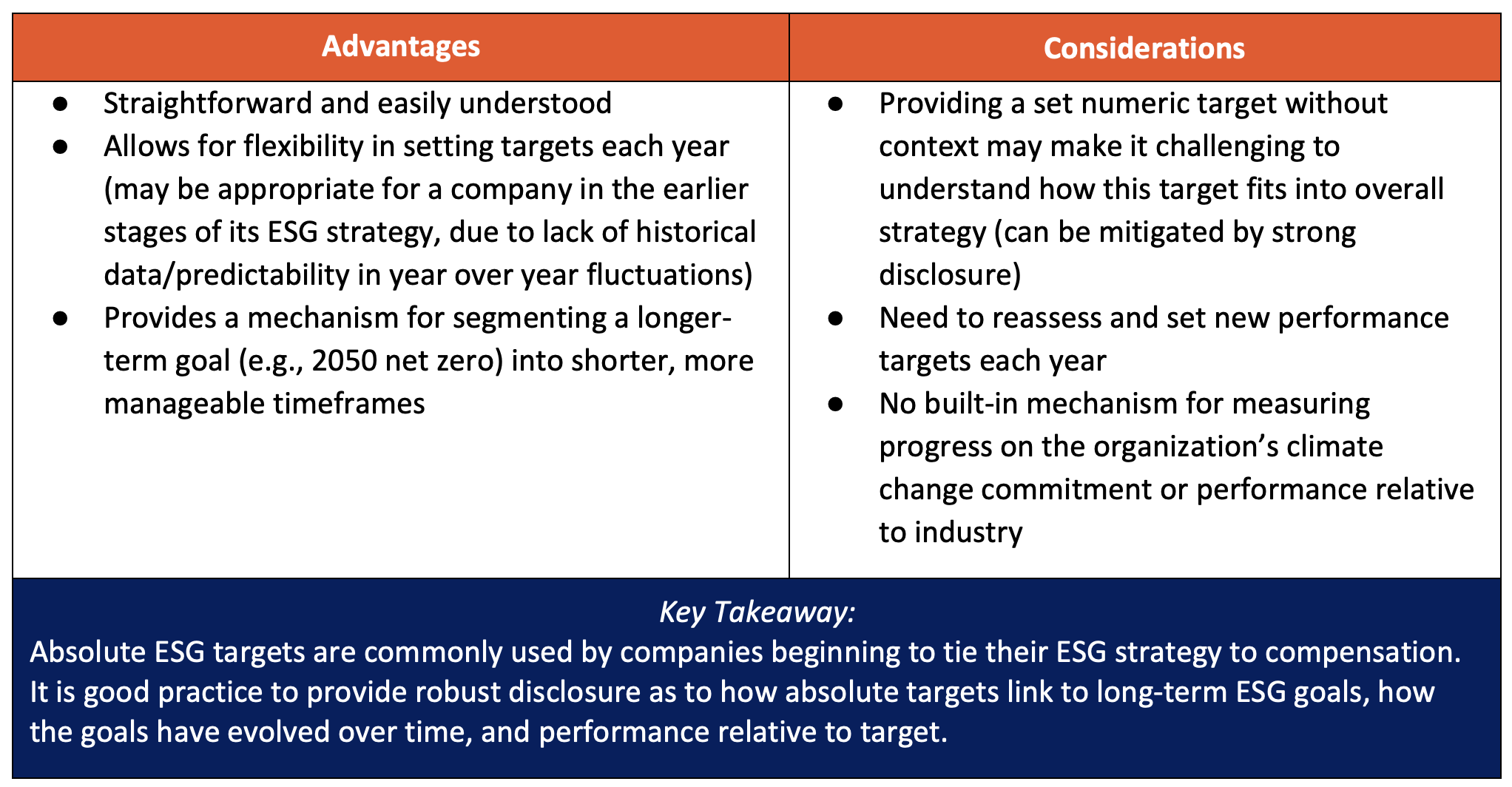
Cenovus Energy (market cap: $29B) develops, produces, and markets crude oil, natural gas liquids, and natural gas internationally. Following its net zero 2050 commitment, the company has begun to incorporate this into its short-term incentive program (“STIP”) through an annual oil sands emissions intensity target with a 2.5% weight in the company’s 2020 corporate scorecard. Cenovus uses an absolute target-setting approach for this metric, which involves choosing a discrete emissions intensity target (e.g., 54.81 CO2e/BOE in 2020), and comparing it to actual results at year end. In 2020, Cenovus reported results of 52.01 CO2e/BOE, resulting in a multiplier of 1.6x on this metric.

Canadian Natural Resources Ltd. (“CNRL”) – Relative Year-Over-Year Target

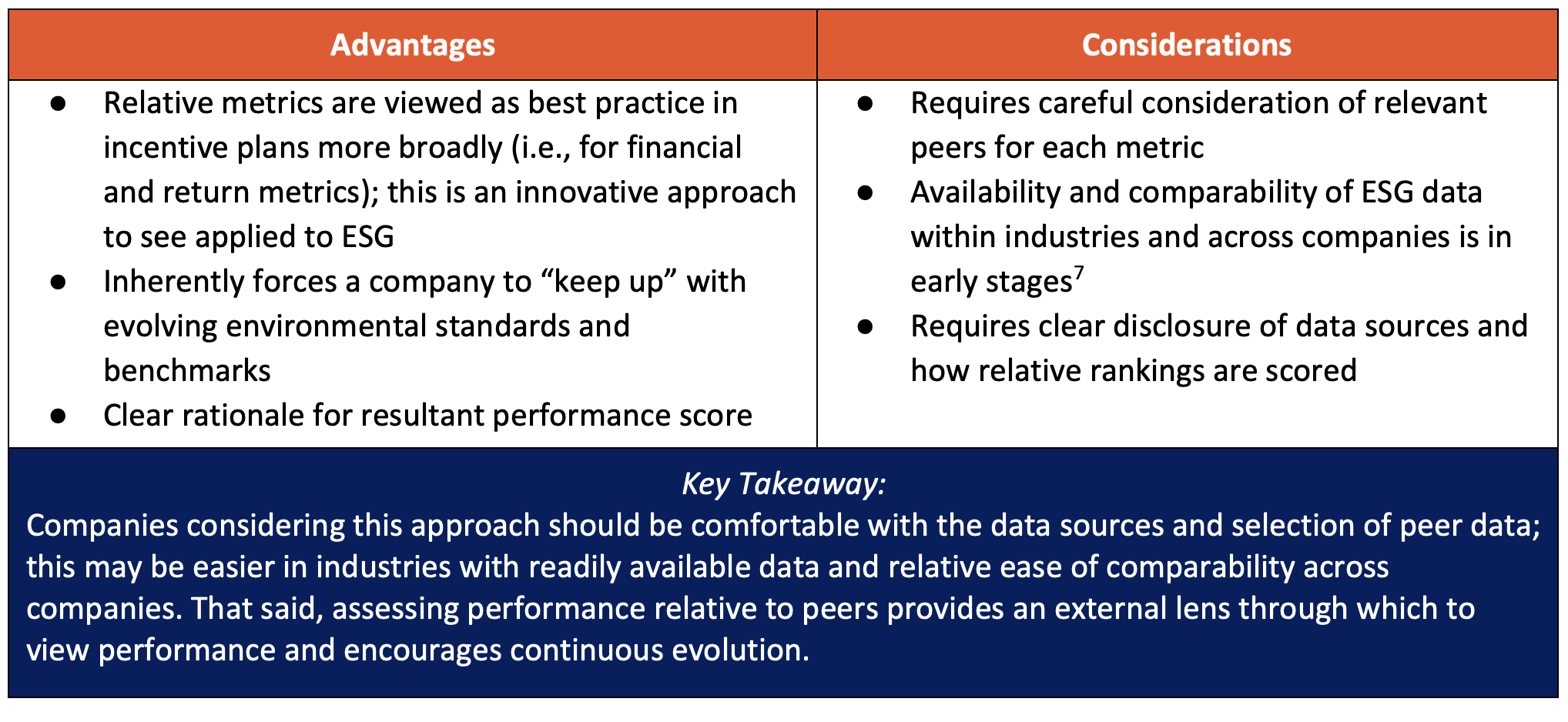
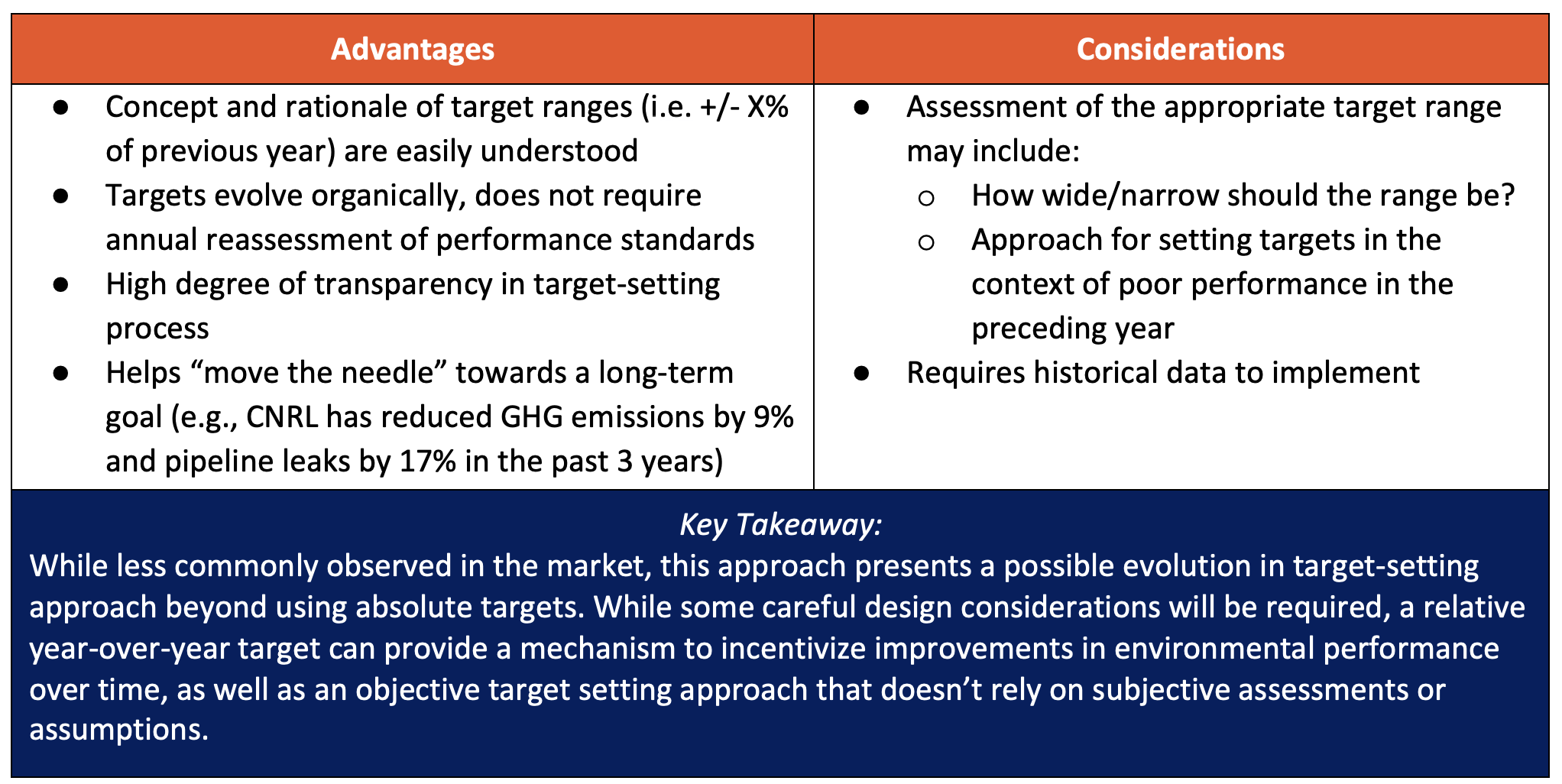
CNRL (market cap: $62B) acquires, explores for, develops, produces, markets, and sells crude oil, natural gas, and natural gas liquids (NGLs). CNRL has incorporated two environmental metrics, GHG emissions intensity and number of pipeline leaks, into its corporate scorecard. While the individual weightings of these metrics are not disclosed, they are two of four metrics included in the Company’s “Safety, Asset Integrity and Environmental” category, which has a 10% weight overall.  CNRL’s target-setting approach for these metrics involves setting targeted reduction ranges relative to the previous year’s results, with a threshold/maximum score of -/+10% (i.e., 2020 target  was 0.046-0.056 tonnes/BOE, which is +/-10% of the 2019 actual result of 0.051). In 2020, the Company performed within the targeted range on these environmental metrics.

Barrick Gold – Target Positioning Relative to Peers

Barrick Gold Corporation (market cap: $43B) engages in the exploration, mine development, production, and sale of gold and copper properties. In 2020, the Company introduced a Sustainability scorecard into its long-term incentive program (“LTIP”). This scorecard has a 25% weight in the performance share units (“PSUs”), and measures performance on 18 quantitative and qualitative ESG metrics (7 of which are environmental) ranked relative to peers where applicable.[5],[6] Barrick’s target range is +/-10% of the previous year’s relative score, with a floor and ceiling of a “Grade A” and “Grade C” relative to peers (defined by sum of positioning on each metric). In 2020, the Company was scored in the top two quintiles of peers on all environmental metrics but one.

Conclusion

These are just some of the approaches to setting performance targets for an incentive plan metric. In selecting an approach specifically for an environmental metric, companies will need to consider where they are in their sustainability journey, the performance metric of choice’s alignment with strategy, and the availability of data among other factors. Regardless of which target-setting approach a company chooses, the key determinants to successfully including an environmental metric into the compensation program will depend on the metric’s ability drive towards the desired long-term objective, the calibration and rigor of the target levels, and the ability to clearly communicate this linkage internally to executives and externally to stakeholders.

Sources:

[1] Hugessen Consulting: “Emerging Trends in Executive Compensation and ESG Webinar

[2] Barrick Gold: “Barrick Updates Its Evolving Emissions Reduction Target

[3] Reuters: “Canadian Natural sets new emission goals after profit beat

[4] Cenovus Energy: “Cenovus sets bold sustainability targets

[5] Barrick Gold: “Barrick Sustainability Report 2020

[6] For indicators based on internal priorities, Barrick evaluates “performance, progress and expectations rather than trying to force equivalence with peer programs”.

[7] Barrick bases its assessment on Sustainability Reports, GRI content indexes and associated data tables, and other publicly available information to determine its relative positioning.

RIA Disclaimer
The views and opinions expressed in this article are solely those of the authors and do not necessarily reflect the view or position of the Responsible Investment Association (RIA). The RIA does not endorse, recommend, or guarantee any of the claims made by the authors. This article is intended as general information and not investment advice. We recommend consulting with a qualified advisor or investment professional prior to making any investment or investment-related decision.

From Pandemic Trends to Permanent Shifts: an Investment Case Study on the Post-Covid Consumer

March 11, 2020, marks the day which the World Health Organization declared the novel Coronavirus (Covid-19) a global pandemic. It was a storm no one saw coming and one that continues to have us wonder when it will come to an end.

We will eventually overcome Covid-19, but will the normal we return to be the normal we once knew? At Waratah, we believe Covid-19 has presented itself as a significant catalyst for change in the world of Environmental Social Governance (“ESG”). When we began our ESG journey 3 years ago, we never expected a pandemic like Covid-19 would be the call-to-action event leading us to quickly adapt how we viewed ESG risks and opportunities in the Alternative ESG (“AESG”) strategy. With each passing month of pandemic-living, themes and trends have emerged, with some very likely to remain permanent.

Being Toronto-based, we experienced among the most restrictive lockdowns in North America (remember when Golf was illegal?). Thankfully, life appears to be slowly normalizing but many of the patterns we’ve developed as consumers in the Covid-era are persisting beyond initial predictions. This piece aims to highlight some of the Covid trends which have likely become permanent shifts, and how important it is for investors to recognize these shifts as opportunities to capture ESG alpha.

Remote Work and Productivity

Workers quickly pivoted to “work-from-home” and Zoom and other video-conferencing providers led the way in facilitating communication, allowing many industries to continue business as usual during the Pandemic. While Zoom fatigue is real, what consumers forget is what it has provided us, a commodity so valuable and finite – our time. We are all spending far less time in transit, enabling us to enjoy more meaningful activities, such as spending time outdoors, having quality time with our immediate families or focusing on our own personal goals. With the vast majority of companies exceeding quarterly estimates, it is evident that Covid has not stalled productivity output, dispelling the myth that home is a detractor of efficiency. Flexibility, once a privilege reserved for freelancers, has made its way into corporate work policies.

Last year Microsoft like many others, announced a hybrid work policy allowing employees to work from home permanently, embracing the fact there is a “no one-size-fits-all” strategy for its staff. From a conventional view, this would be not newsworthy, but from an ESG perspective, this is a significant social highlight, as we believe employee satisfaction is an important metric to measure productivity, human capital retention and talent recruitment. With the threat of the “Great Resignation” looming, Waratah believes companies embracing flexibility and a better work-life-balance will fare better than companies with less accommodating policies and cultures.

Consumer Spending Habits

With travel still largely on pause, another effect of Covid was spending the last year and half at home. This gave rise to the Waratah thematic of “home as a sanctuary” which led to the inevitable, the home improvement capex cycle. This emerging thematic contributed to several great alpha-generating opportunities. With pent up consumer demand and few places to go, it was evident that consumer spending would be geared towards people’s homes as they became our offices, restaurants, bars, and entertainment centres. With the rise in takeout dining and the increased environmentally conscious consumer, greener solutions were in demand, reinforced by polices banning single use plastics. Companies that embraced these changes early-on became top contributors to our portfolio. One example is a package manufacturer, who produces paper takeout boxes as an alternative to the typical non-recyclable black plastic. Other Covid beneficiaries such as Disney’s streaming and video on demand service created tremendous value given the idea of attending a packed movie theater seems even now, a risky proposition. As consumers ourselves, our team focused on unique and atypical areas of the market where we saw opportunity. An example is this past Summer, on the heels of several initial public offerings, our team was able to get behind a trend we were all enjoying and extract return from various IPOs under this theme over the summer. Even with the return to school and the office, it’s hard to argue with Dorothy: “there’s no place like home.”

Safe and Healthy Environments

The last Covid trend to highlight is Heating, Ventilation and Air Conditioning (HVAC), one we see as a long run-way opportunity. HVAC accounts for 15% of the world’s Greenhouse Gas emissions (GHG) generated by commercial buildings[1] from schools, offices, and hospitals. While consciousness around GHG emissions is not a new awareness, what has been amplified because of Covid-19 is consumer demand for improved air quality and the reduction of circulated allergens, chemicals, and bacteria. We all know someone who ran out to buy HEPA air filters or voiced concerns over recirculated plane air. In the United States alone, 70% of all schools reportedly failed indoor air quality tests,[2] a stat which is likely applicable to most commercial buildings as well. As such, we see HVAC as a massive 10–20-year infrastructure ESG tailwind that will long outlive Covid. Governing policies like “Build Back Better” have ear-marked $193 billion to improving school infrastructure moving forward[2] in hopes that other ESG risks, such as another pandemic or environmental disaster doesn’t hold us hostage yet again.

The effects and impact of Covid on both ESG and consumers is undeniable. While many of us would like to forget the last year and half, we are all forever changed by it.  As we move on from this pandemic, consumer demand has shifted, and they will continue to expect and strive for cleaner, healthier, and happier lives. Through our ESG lens, a differentiated approach and ability to recognize these changes in consumer behaviour early allows investors to take advantage of less-obvious ESG opportunities as sources of alpha.

Sources:

[1] Source: Credit Suisse Trane Technologies Equity Research Report (March 2020)

[2] Source: JCI CFO at the MS Laguna conference on Sep 13

Contributor Disclaimer
Waratah may change its views in the subject companies discussed in this article at any time for any reason and disclaims any obligation to notify any party of such changes. The information and opinions contained in this article are not and should not be perceived as investment advice or a solicitation to buy or sell securities. Waratah makes no representation or warranty, express or implied as to the accuracy or completeness of the statements made in this article nor does it undertake to correct, update or revise those statements.
RIA Disclaimer
The views and opinions expressed in this article are solely those of the authors and do not necessarily reflect the view or position of the Responsible Investment Association (RIA). The RIA does not endorse, recommend, or guarantee any of the claims made by the authors. This article is intended as general information and not investment advice. We recommend consulting with a qualified advisor or investment professional prior to making any investment or investment-related decision.

Pathways to Integrate Reconciliation & Responsible Investment

Diversity has become a central theme in the investment industry. In 2018, SHARE (Shareholder Association for Research and Education) and NATOA (National Aboriginal Trust Officers Association) joined their efforts to create the Reconciliation and Responsible Investment Initiative (RRII) . The RRII has been spearheading the efforts to integrate reconciliation and responsible investment. In 2020, the Responsible Investment Association (RIA) of Canada, started an initiative to lead investors managing more than $4 trillion in assets to sign a statement to make commitments to promote Diversity & Inclusion across their organizations and portfolio companies.

Despite those recent initiatives, few Canadian RI policies or reports of institutional investors make references to Indigenous peoples. Beyond the recognition of Indigenous rights within due diligent processes linked to the Free, Prior, and Informed Consent (FPIC), Indigenous Peoples and their economic, social, and environmental well-being are relatively absent from the conversations in the Canadian Responsible Investment (RI) industry. [Editor’s Note: The recent Canadian Investor Statement on Climate Change signed by 36 investors managing $5.5 trillion in assets emphasizes the importance of Indigenous rights for investors.]

Faced with this observation, we decided to investigate further. As a research team at the Ivey Business School, Western University, we studied the practices of the industry for one year through interviews with stakeholders, observation of industry conferences, and documentary evidence. Our results are available in a new report that sheds light on the significant differences in the level of awareness of, and action on, Indigenous rights and reconciliation among the Canadian investment management firms.

This report aims to create a safe space to engage the Canadian responsible investment industry in the process of truth and reconciliation. It outlines the current relationships between Indigenous peoples and the RI industry in Canada and offers recommendations to build bridges and make progress towards reconciliation.

We examine how the Canadian RI industry specifically embraces six sub-themes deemed key to the process of economic reconciliation, to wit: 1) Recognition of Indigenous rights; 2) Diversity and inclusion (of Indigenous peoples); 3) Building a thriving Indigenous economy through partnership; 4) Fiduciary duty and Indigenous peoples; 5) Building an inclusive and just transition to a low-carbon economy through partnership; and 6) Indigenous environmental stewardship. We systematically analyze the inclusion of each theme in each step of the investment chain, from asset owners, asset managers to investee companies, and service providers.

Responsible investors usually assess Indigenous rights and concerns through the lens of risk management. While risk management is a critical component for investment decisions, it limits opportunities for the RI industry to contribute to reconciliation or the building of opportunities for all peoples to achieve their full potential and shared prosperity. The report recommends several steps that actors across the investment chain could implement to progress on the path of reconciliation. Possible actions include Investing in Indigenous-led (impact) investing products, Implementing comprehensive policies on Indigenous representation among employees and boards of directors, designing procurement policies for Indigenous businesses or educating and engaging Indigenous investors on proxy voting that relates to Indigenous rights, By engaging in reconciliation, the Canadian RI industry can lead the integration of ‘I’ in ESG and transition towards a climate-resilient and inclusive economy worldwide.

We believe that economic actors must address social inequalities and systemic racism to contribute to inclusive growth that creates opportunities for all. Including Indigenous peoples in the allocation, distribution, and valuation of capital is an essential step towards this endeavour. In addition, inclusive companies that manage ESG risks and improve outcomes for Indigenous peoples are also better investments.

The report is also an example of the current Canadian business schools’ efforts to respond to the Truth & Reconciliation Commission (TRC)’s Call to Action 92, which offers a roadmap for the business community to think about and practice reconciliation. Historically, Canadian universities played a central function in the processes of colonization. Indigenous peoples have had limited access to the universities and still, to this day, are underrepresented, under-resourced and neglected by researchers in the university system.

As business school scholars, we recognize there is much work to be done, and that the practice of reconciliation requires sustained commitment to not only actions, but also a sustained practice of confronting the places within current financial systems and sectors where Indigenous voices are absent. The following report not only maps out the spaces and places within the Canadian responsible investment industry where Indigenous voices are needed, but also offers a necessary roadmap for how this sector and its partners may begin to walk a path toward honouring truth and practicing reconciliation.

The report can be found at https://www.ivey.uwo.ca/sustainability/priorities/finance/

RIA Disclaimer
The views and opinions expressed in this article are solely those of the authors and do not necessarily reflect the view or position of the Responsible Investment Association (RIA). The RIA does not endorse, recommend, or guarantee any of the claims made by the authors. This article is intended as general information and not investment advice. We recommend consulting with a qualified advisor or investment professional prior to making any investment or investment-related decision.

Three Key ESG Trends Advisors Need to be Aware Of

As responsible investment (RI) continues to grow and evolve at a rapid pace, it is important for investment advisors to stay abreast of key trends and leading practices in the field. Of course, that is easier said than done in a pandemic world that has been characterized by chronic stress and nonstop Zoom meetings — especially when the RI market is evolving so quickly.

To help you stay informed in this fast-moving market, this article provides a quick overview of three big issues in RI that every advisor should know about: stewardship, impact measurement and net zero.

Investment stewardship

The concept of stewardship is gaining prominence among investors in Canada and globally, but what exactly does it mean in practice? While some market participants use the terms “stewardship” and “engagement” interchangeably, leading researchers and practitioners point out that good stewardship is much broader than shareholder engagement alone.

A 2020 report from KKS Advisors, a consultancy led by Harvard professor George Serafeim, stated that “stewardship reflects the role of investors as ‘stewards’ of the assets entrusted to them by their clients and the responsibility of investment professionals to carefully protect and enhance the value of those assets. It embodies the notion that investors are influential market players who have the power to shape markets, enhance governance and address market risks and opportunities affecting the health of the economy.”

Upon analyzing the stewardship practices of 40 of the world’s largest institutional investors, KKS Advisors concluded that stewardship has seven practical components:

  1. Influence – Leveraging investors’ position within the financial system to drive a sustainable economy; for example, by raising ESG standards and promoting effective policies and regulations.
  2. Engagement – Proactive dialogue with companies on ESG issues.
  3. Voting – Communicating and exercising shareholder rights and expectations.
  4. Promoting disclosure – Encouraging high-quality disclosure of ESG information.
  5. Monitoring – Actively monitoring ESG performance and new regulations.
  6. Collaboration – Participating in collective action and coordinating with peers to maximize impact.
  7. Education – A commitment to internal ESG training and development.

Advisors who are interested in stewardship of their clients’ assets can use this list as a point of reference when examining asset management firms.

Impact measurement

Impact investing is also gaining prominence in the asset management industry. The Global Impact Investing Network defines impact investing as “investments made with the intention to generate positive, measurable social and environmental impact alongside a financial return.” The key components here are intentionality and measurement. If positive impacts are not intentional and measurable, then we are not talking about an impact investment.

In the context of rising investor demand for positive impact and growing concerns about greenwashing, it is vitally important for fund managers to measure and report on the positive impacts that their clients’ assets are generating. The importance of credible impact measurement is compounded by the fact that we are seeing a growing number of public equity funds marketed as impact investments.

While there are numerous credible impact measurement frameworks on the market, there is no global standard across asset classes. This can make it challenging for investors and advisors to compare impact investments. As a result, the Impact Management Project (IMP) is seeking to build a global consensus on how to measure, manage and report the impacts of an investment. Here in Canada, the IMP has partnered with Rally Assets on their flagship education project called Impact Frontiers, which seeks to build the capacity of investment managers to integrate impact and financial management. These projects will take some time to play out, but given the weight behind IMP, whose advisors include PWC, KPMG, UBS, Bank of America, Ford Foundation and Dutch pension fund PGGM, among others, we can expect to see some level of convergence in the next few years.

In the meantime, fund managers should make use of the most credible tools and methods available to measure and report their positive impacts. Failure to do so could exacerbate concerns about greenwashing in the market. Advisors who want to see impact metrics from fund managers should communicate their expectations to the manager.

Net zero

You have likely seen headlines about “net zero” popping up in your newsfeed. Here’s why it’s a big deal right now in the investment industry.

The Intergovernmental Panel on Climate Change, a United Nations science agency, has reported that in order to avoid catastrophic impacts from climate change, we must limit the average global temperature rise to no more than 1.5°C above the preindustrial era. To achieve this target, global carbon emissions must decline by about 45% relative to 2010 levels by 2030 and reach net-zero by approximately 2050.

Governments around the world, including Canada, are pledging to reduce emissions in alignment with these targets. However, meeting these commitments will require a massive transition of the global energy system, creating risks and opportunities across sectors. These transition-driven risks are compounded by the physical risks flowing from a changing planet.

As a result, many companies and institutional investors are now making pledges to align their business and investment practices with net zero emissions. These commitments send a signal to the market that the business intends to manage the risks and capitalize on the opportunities of a transition to a low-carbon economy.

Conclusion

Stewardship and impact investing are two of the most important strategies available to investors who are interested in achieving net zero emissions. That’s because stewardship can help move companies toward more sustainable outcomes, and impact investing can help move capital toward industries, companies and projects that help drive down emissions. The key is that the positive impacts need to be measurable. If they are not, then it’s not clear that the needle is moving.

A version of this article was originally published in Investment Executive. Read the full article here.

Net Zero Scenarios: An Investor’s Perspective

While climate change is a complex issue often discussed as a source of risks, it also creates a new realm of opportunities for investors. However, if investors are to be successful over the long term, they must have the capability to identify and manage these risks and opportunities efficiently, which requires a deep understanding of the relationship between climate and the financial markets, two highly dynamic and interacting systems.

Carbon foot-printing is one of the tools available to help understand historic exposure to transition risks and when paired with comprehensive knowledge of the business, it provides valuable insights into a company’s ability to manage the impacts of future climate change. The outlook generated by the analysis, however, can sometimes be less useful in evaluating the future resilience of an asset or portfolio. On the other hand, scenario analysis, that includes a range of reasonable climate transition outcomes, can provide better insight into the strengths and weaknesses of a portfolio as well as its level of alignment with desired climate outcomes. In this article, we will discuss the application and assessment of climate scenarios for investment portfolios.

Investors can apply scenarios to investment strategies in the same way companies apply scenarios to their capital planning process to test resiliency under a variety of potential future outcomes. The International Energy Agency (IEA), Intergovernmental Panel on Climate Change (IPCC) and the United Nations-backed Principles for Responsible Investment (PRI) all offer a wide range of scenarios that are calibrated to climate change-related outcomes ranging from “business as usual” to “Net Zero by 2050”. There are three key considerations when applying these types of scenarios to investing:

  • Scenarios ≠ Forecast: Scenarios involve numbers and a view of the future that can lead investors to an assumption that there is a single path to one future outcome. With any scenario, especially multi-decade climate scenarios, there is a great deal of uncertainty associated with factors such as international coordination, consumer behavior, technological innovation and corporate strategies. Therefore, the resilience of portfolios can really only be tested by using a range of scenarios that focus on what “could” reasonably happen rather than what “should” happen. Key outputs are the distribution, magnitude and likelihood of events that can be mapped back to long-term investment value creation and current market expectations.
  • Investment-relevant parameters: Most current scenarios require knowledge of a specific business and expertise in translating factors like warming potential and carbon price into parameters that can influence a financial model. More recently, a joint effort was initiated by central banks and governments to standardize a range of scenarios that will likely further delineate key metrics such as credit and liquidity risk. Even more granular scenarios like the IEA Net Zero by 2050 will also help to bridge the existing gap.
  • Time Frame: Although there is a general sense that the impacts of climate change are more imminent than ever, the larger and more likely impacts on earnings and cash-flows are potentially still outside of the 5.5-month average holding period for assets like U.S. equities. That being said, a more thoughtful approach to the implied long-term growth rates in multiples and terminal assumptions of a valuation model can help to incorporate medium- to long-term changes into even shorter-term investments.

Net Zero(ish)

With the increased momentum in country and corporate transition strategies and the growth in physical changes influenced by climate change, it seems sensible to include a net-zero scenario in the range of options to test the resilience of an investment portfolio. However, the term “net zero” is used in different ways by different groups. The IEA’s recent Net Zero by 2050 provides a detailed and economically relevant example of a scenario that defines “a” path and applies additional analysis looking at the sensitivity of their scenario to key areas of uncertainty such as changes in consumer behavior, technological innovation, energy security and use of nuclear and carbon capture. Regardless of the label, investors need to critically assess a number of parameters to understand the commitments made by companies and the commitments they may consider for their own portfolio:

  1. Accountability: Who has the mandate to achieve the goal and how are they incentivized to reach it?   For industries with high levels of exposure, it could involve the implementation of a specific board committee and climate-related linkages to executive compensation.
  2. Alignment: Alignment with the capabilities and value creation of the business (or investor) and the relevant commitments of peers and local governments. The path to net zero can have varying meanings across different industries and regions.
  3. Base Year: The reference year for emissions is usually not the current year and needs to be assessed based on the quality of the data available and the percentage of reductions that are expected to come in the future.
  4. Scope: The decision to commit to intensity or total emissions reductions will depend on the growth trajectory of the business or the portfolio. However, there is often an expectation for businesses to be focused on total emissions over time. According to the GHG Protocol Corporate Standard, a company’s emissions can be classified in three scopes. Scope 1 and 2 reductions should be seen as standard disclosures. Scope 3 emissions should be critically assessed for coverage, available data and reasonableness, as they are voluntary and the hardest to monitor.
  5. Milestones: At a minimum, there needs to be high-level targets and milestones for 2030 and 2050, but some indication of an iterative process with 3- to 5-year windows for reassessment would be positive.
  6. Offsets and Innovation: It is difficult to imagine achieving Net Zero by 2050, without the use of carbon offsets and new technology. Offsets should be evaluated on transparency, total contribution, whether they avoid or reduce emissions and the relative risk of reversal. Innovation’s contribution should be transparent about uncertainties and the amount of reductions coming from earlier-stage technology.

Conclusion:

Despite the challenges related to the kind of analysis required, there is likely to be value for investors and other stakeholders in trying to integrate the analysis of the risks and opportunities associated with climate change across their portfolios. Ultimately, successful investors are ones that have greater or faster access to information and find inefficiencies enabling them to better manage risk and capture return. Building portfolios that can be resilient through a variety of different climate futures can be beneficial to asset owners and society as a whole.

RIA Disclaimer
The views and opinions expressed in this article are solely those of the authors and do not necessarily reflect the view or position of the Responsible Investment Association (RIA). The RIA does not endorse, recommend, or guarantee any of the claims made by the authors. This article is intended as general information and not investment advice. We recommend consulting with a qualified advisor or investment professional prior to making any investment or investment-related decision.

How Investors Can Drive Change in Canadian Nursing Homes

Before the outbreak of the Covid-19 pandemic, healthcare issues at nursing homes were often overlooked. The past year starkly demonstrated that inadequate working conditions and inadequate elderly care are important human rights issues that urgently need to be addressed. As investors, we must contribute to driving positive change in this sector.

Many nursing home staff work in stressful environments. They often earn low wages on part-time hours or through precarious arrangements – in some countries without sick pay or union representation. Most staff are women, and often they are minorities or from marginalized backgrounds. Nursing homes struggle to attract and retain enough workers to meet current demands, let alone the need for more caregivers to match demographic shifts. The staff-to-resident ratio in many homes is inadequate to provide even basic care to residents, let alone the quality required during a pandemic.

The glaring spotlight of Covid-19

During the pandemic, nursing home workers have been caring for those most vulnerable to the virus in extremely high-risk environments. The sector found itself in the eye of the storm, largely owing to a global unpreparedness for a pandemic of this scale and failures by governments to support and regulate nursing homes and their residents. This exacerbated the inherent vulnerabilities of aged care, and led to some very sobering numbers:

  • According to this report, an average of 41% of all deaths across 22 countries happened in nursing homes.
  • Hundreds of thousands of nursing home staff became infected during the pandemic – many of whom either died or are now facing long-lasting aftereffects.

Throughout the pandemic, scandals relating to nursing homes were prevalent. In Canada, this report by the International Longevity Centre declared the diminishing recognition of the human rights of older people as the most severe impact of the Covid-19 pandemic; a statement that speaks volumes and is backed up by plenty of alarming information relating to rising elder abuse and ageism, among other violations of health care regulations, within nursing homes.

Meanwhile, healthcare workers at Responsive Group’s Rykka Care Centres filed a human rights complaint for gender and skin colour discrimination, calling for better working conditions and the replacement of management at the centres. The provincial government was also named a Respondent for its failure to properly regulate and oversee operations at long-term care homes.

In the UK, Amnesty International reported that a series of “shockingly irresponsible” decisions taken by Government – including the decision to discharge infected hospital patients to nursing homes – risked the lives of tens of thousands of elderly people and led to multiple violations of their human rights. One year into the pandemic, research by UNI found that most care workers still do not earn a liveable wage, and nearly a third are without adequate access to personal protective equipment.

Why does this matter to investors?

As nursing homes recover from the virus, we must use this opportunity to improve the sector permanently by developing a more resilient and humane working model. Doing so will address fundamental human rights issues and contribute to a fairer and more sustainable society for us all.

If human rights weren’t reason enough to demonstrate why improving this sector is so important, there are also important business reasons to consider. Better working standards will promote better care, ultimately helping to mitigate legal, reputational and operational risks for companies within this sector. For example, this Bloomberg Canada news story from May 2020 reports on plunging shares in long-term care home companies in the aftermath of the Ontario care scandal, whereby a Canadian Armed Forces report detailed “horrific” treatment of residents.

Practical takeaways and actionable steps for investors

Companies must raise standards for working conditions and quality of care, but the weight doesn’t fall solely on their shoulders: governments and regulators must ensure that regulatory environments and funding provisions enable nursing homes to meet higher standards. As investors in this sector, our role is to set clear expectations of companies for improving these standards.

Along with 99 other financial institutions and representing $3.5trn in combined assets under management and assets under advice, we developed and signed the UNI Global Union investor statement on expectations for the nursing home sector. The statement is still open to be signed and supported by investors. We’re asking investee companies:

  • To develop and implement standards that not only adapt to, but go beyond local regulatory requirements for understaffing, health & safety, wages, collective bargaining and quality of care.
  • That own real estate used for nursing homes – such as Real Estate Investment Trusts – to support operators in meeting these expectations by overseeing their properties and monitoring processes to ensure our standards are met.

At BMO GAM we have contacted 13 nursing home companies and trusts to urge appropriate staffing levels, improved health and safety standards, proper use of PPE, fair wages, pandemic hazard pay, and freedom to unionize. At the time of writing, three of these have responded, with dialogues due to take place soon.

We have also supported AGM questions at Fresenius SE around labour standards , and shareholder proposals filed by fellow investors at companies such as Chartwell Retirement Residences, requesting more information on human capital management and paying a living wage to staff.

Final thoughts

We believe these expectations have come at a crucial time: the bar for working conditions and quality of care in nursing homes clearly needs to be raised, and we look forward to working with companies and other investors to create change for good. We believe that addressing these issues will improve confidence across investors, regulators, workers, residents and their families in the nursing home industry – in this period of grave concern and beyond.

Contributor Disclaimer
BMO Global Asset Management is a brand name that comprises BMO Asset Management Inc., BMO Investments Inc., BMO Asset Management Corp., BMO Asset Management Limited and BMO’s specialized investment management firms.
®/™Registered trade-marks/trade-mark of Bank of Montreal, used under licence.
RIA Disclaimer
The views and opinions expressed in this article are solely those of the authors and do not necessarily reflect the view or position of the Responsible Investment Association (RIA). The RIA does not endorse, recommend, or guarantee any of the claims made by the authors. This article is intended as general information and not investment advice. We recommend consulting with a qualified advisor or investment professional prior to making any investment or investment-related decision.